
Careers › Where Do You Want to Work? › Deep Sea / Worldwide

Facts checked against MARAD, NMC, Military Sealift Command, SIU and eCFR sources · October 2026
For some mariners, the attraction is the ocean passage itself: large ships, extended voyages and work far beyond a local operating area.
They want a career that can take them across oceans and into international trade.
That is the deep-sea side of the maritime industry.
It can include containerships, tankers, vehicle carriers, roll-on/roll-off ships, bulk carriers, government sealift vessels and other oceangoing ships.
For a newcomer, there is an important reality:
Deep-sea work often involves more international documentation, more extensive qualifications and longer periods away from home than many local maritime jobs.
That does not make it better.
It makes it different.
This page focuses on pathways for U.S. mariners, particularly employment aboard U.S.-flag commercial and government-operated vessels.
Foreign-flag employment may involve different credential recognition, contracts and national requirements.
What Do We Mean by “Deep Sea”?
For this page, deep sea means oceangoing commercial or government vessel employment involving extended voyages and, in many cases, international service.
It describes a working environment, not a separate Coast Guard endorsement.
A deep-sea mariner may work aboard:
- Containerships
- Tankers
- Vehicle carriers
- Roll-on/roll-off ships
- General cargo vessels
- Bulk carriers
- Government sealift vessels
- Specialized cargo ships
- Research or support vessels on extended voyages
MARAD’s August 2026 dashboard listed 190 U.S.-flag, self-propelled, oceangoing merchant vessels of 1,000 gross tons or more.
That is a defined merchant-fleet category—not a count of every U.S. vessel capable of going to sea. (maritime.dot.gov)
The fleet includes vessels enrolled in the Maritime Security Program, or MSP.
Those privately owned U.S.-flag commercial ships operate in international trade and are available under agreement to support national-defense sealift.
The MSP currently supports 60 ships.
Those 60 are part of the broader fleet picture; they should not be added to the dashboard total as though they were a separate fleet. (maritime.dot.gov)
For career planning, the bigger point is simple:
There is a U.S.-flag deep-sea industry, but it is a specialized part of the broader maritime workforce.
Two Questions: How Do You Qualify, and How Do You Get Hired?
New mariners sometimes treat these as the same question.
They are related, but different.
How You Prepare or Qualify
Possible pathways include:
- Entry-level credentialing followed by employer training
- A structured apprenticeship
- A maritime academy
- Other officer-qualification pathways
- Advancement from an unlicensed position through qualifying service and additional requirements
How You Obtain Employment
Hiring arrangements can include:
- Direct company employment
- Union dispatch or referral
- Federal civilian hiring
- Employment with a private company operating ships under a government contract
A training pathway and a hiring system can overlap.
For example, the Seafarers International Union’s Unlicensed Apprentice Program combines structured training with a pathway toward employment aboard SIU-contracted vessels.
That does not mean every apprenticeship or academy uses the same employment arrangement. (seafarers.org)
Do not investigate only the ship.
Investigate the employment system behind it.
That system affects how you find work, how assignments are made, how reliefs are arranged, what benefits apply and how you advance.
What Kinds of Ships Work Deep Sea?
Containerships
Containerships carry standardized containers holding manufactured goods, machinery, food, consumer products and other cargo.
Depending on their positions, deck officers may work with:
- Navigation
- Watchstanding
- Cargo planning
- Stability
- Port operations
- Safety management
Unlicensed deck personnel may perform:
- Mooring
- Maintenance
- Cargo-related deck duties
- Safety-equipment work
- Watch duties for which they are qualified
A ship may spend days crossing an ocean and then become very busy shortly before arrival and while alongside.
Tankers
Tankers carry liquid bulk cargoes such as:
- Crude oil
- Petroleum products
- Chemicals
- Other authorized liquid cargoes
Working aboard a tanker does not mean every crewmember serves as the Person in Charge, or PIC, of cargo transfers.
National endorsements such as Tank Vessel-PIC and Tank Vessel-Assistant have their own qualification requirements. (dco.uscg.mil)
Where STCW applies, personnel may also need tanker qualifications appropriate to the cargo and their assigned responsibilities.
National tank-vessel endorsements and STCW tanker endorsements are related but separate qualifications.
Do not buy tank-vessel training simply because you want to work on a tanker.
First identify the position and cargo duties.
Then determine which national and STCW qualifications apply.
Roll-On/Roll-Off Ships and Vehicle Carriers
Roll-on/roll-off vessels, commonly called Ro-Ros, carry wheeled cargo that can be driven or rolled aboard.
Vehicle carriers and other Ro-Ro ships may transport:
- Cars
- Trucks
- Heavy equipment
- Military vehicles
- Other rolling cargo
Some ships combine container and Ro-Ro capability.
Cargo securing, stability, ventilation and loading arrangements can make these vessels different from tankers or bulk carriers.
General Cargo and Other Ships
Other deep-sea employment may involve:
- General cargo ships
- Heavy-lift vessels
- Project-cargo ships
- Dry bulk carriers
- Government cargo ships
- Auxiliary vessels
- Research and specialized support vessels
Do not choose the career solely by ship type.
Two ships carrying similar cargo can have different employers, crew structures, schedules and hiring arrangements.
Deck Careers
Deep-sea deck careers include unlicensed ratings and licensed officers.
A simplified career illustration might look like:
This is an illustrative path—not an automatic promotion sequence or the only route.
Advancement depends on the endorsement being pursued and applicable requirements involving:
- Qualifying sea service
- Vessel tonnage
- Route
- National endorsements
- STCW endorsements
- Training
- Assessments
- Examinations
The National Maritime Center maintains separate national and STCW deck qualification checklists.
Obtaining one endorsement does not automatically provide every qualification needed for the next position.
For someone who enjoys navigation, seamanship, cargo operations and eventual shiphandling responsibility, the deck department deserves a close look.
Engine Careers
Deep-sea engineering positions may include:
- Wipers
- Qualified Members of the Engine Department, or QMEDs
- Licensed assistant engineers
- Chief engineers
- Electricians
- Refrigeration personnel
- Electronics personnel
- Other technical specialists
The exact positions depend on the vessel and employer.
A simplified progression might look like:
Again, this is not an automatic sequence or the only qualification pathway.
The endorsement needed depends on factors such as propulsion, power, vessel limitations and the position.
Engineering work can involve:
- Main propulsion machinery
- Electrical systems
- Generators
- Pumps
- Boilers
- Automation
- Refrigeration
- Cargo machinery
- Maintenance and troubleshooting
Large ships are floating industrial plants.
Someone has to keep the systems running.
Steward, Culinary and Supply Careers
Ships also need people who feed and support the crew.
Depending on the vessel and employer, positions may include:
- Stewards
- Cooks
- Bakers
- Utility personnel
- Supply personnel
- Pursers
Some employers have specialized logistics and administrative positions as well.
Military Sealift Command’s Purser position, for example, supports shipboard personnel and administrative functions. (sealiftcommand.com)
These careers are worth investigating if food service, organization, provisioning or crew support fit your strengths.
Maritime employment is not limited to the bridge and engine room.
National Credentials and STCW: Two Related Systems
For deep-sea work, understanding the relationship between national and STCW qualifications becomes particularly important.
STCW stands for the International Convention on Standards of Training, Certification and Watchkeeping for Seafarers.
For U.S. mariners, STCW endorsements exist alongside national Coast Guard endorsements.
New to this distinction?
Our guide explains how national and STCW endorsements fit together, with examples.
National vs STCW Endorsements →National and STCW Ratings Are Not Interchangeable
For example, the National Maritime Center maintains separate requirements for the national Able Seafarer ratings and the STCW Able Seafarer–Deck endorsement. (national checklist · STCW checklist)
The STCW endorsement requires an appropriate national qualification plus additional applicable requirements.
Across different positions and career stages, STCW deck qualifications may include:
- Rating Forming Part of a Navigational Watch, or RFPNW
- Able Seafarer–Deck
- Officer in Charge of a Navigational Watch, or OICNW
- Chief Mate
- Master
These are examples across a career.
They are not one package an entry-level applicant must obtain.
Engine personnel likewise have national qualifications and separate STCW watchkeeping, operational and management-level requirements.
The useful lesson is:
A national endorsement does not automatically complete the international qualification requirements for every job.
Does Every Deep-Sea Mariner Need the Same STCW Package?
No.
Requirements depend on:
- Vessel
- Tonnage
- Propulsion power
- Position
- Assigned duties
- Voyage
- Applicable exemptions
Use the current National Maritime Center checklist for the endorsement you intend to pursue and confirm the employer’s requirements.
Do not decide based only on a job advertisement using the words deep sea or international.
Basic Training Is Only One Part of STCW
Many newcomers hear STCW and think only of Basic Training.
Basic Training covers four subject areas:
- Personal survival techniques
- Fire prevention and firefighting
- Elementary first aid
- Personal safety and social responsibilities
It is not the complete qualification system.
Depending on the position, other requirements may address:
- Watchkeeping
- Survival craft
- Advanced firefighting
- Leadership
- Medical duties
- Other position-specific competencies
Consult the applicable checklist rather than assuming one course prepares you for every shipboard position.
Security Requirements Are Separate
Security familiarization, security awareness and training for designated security duties are different requirements.
The appropriate level depends on the person’s assignment.
Do not assume every security course or endorsement serves the same purpose.
Before paying for training, establish:
- What the Coast Guard requires
- What STCW requires
- What the employer requires
- What training the employer or entry program provides
Passport and International Travel
For international assignments, ask the employer which travel documents must be valid before dispatch.
Depending on the voyage and joining arrangements, the employer may identify requirements involving:
- A passport
- A visa
- Health or vaccination documentation
- Company travel instructions
- Seafarer-related entry or immigration documents
Do not assume that serving aboard a U.S.-flag ship eliminates foreign entry requirements.
Also ask:
- Who arranges the documentation?
- Who schedules appointments?
- Who pays fees?
- Who arranges travel?
- Which expenses are reimbursed?
Requirements can depend on the actual assignment.
How Do Deep-Sea Mariners Find Jobs?
Direct Company Employment
Some operators hire mariners directly.
You apply to the company, complete its hiring process and may receive assignments within its fleet.
Investigate:
- Whether employment is permanent, relief or voyage-based
- How vessel assignments are made
- Whether you normally return to the same ship
- How training and advancement are handled
- What happens between assignments
Union Hiring and Dispatch
Some deep-sea employment uses maritime union hiring, referral or dispatch systems.
The process varies by union, department, agreement and employer.
Before relying on this pathway, learn:
- Eligibility and registration requirements
- Documents needed before dispatch
- Applicable shipping or seniority rules
- Training requirements
- Fees or dues
- How work is offered
- Whether openings are available for your qualifications
Do not assume union membership guarantees immediate employment.
Apprenticeship
A structured apprenticeship can be worth investigating if you have little or no maritime experience.
The Seafarers International Union’s Unlicensed Apprentice Program combines classroom instruction with shipboard apprenticeship and provides a pathway toward employment aboard SIU-contracted vessels. (seafarers.org)
Its admission and enrollment process has stages involving testing, screening and documentation.
Follow the program’s current instructions rather than buying training or completing every possible credential step on your own before applying.
What is required to begin an application may differ from what must be completed before enrollment or shipboard assignment.
Maritime Academies
A maritime academy is a structured education and officer-qualification pathway.
For someone whose goal is licensed deck or engineering work, it deserves comparison with other routes.
For someone whose immediate objective is simply to obtain an entry-level berth, a different pathway may fit better.
Compare:
- Time commitment
- Cost
- Credential objective
- Shipboard training
- Employment options after graduation
Do not choose an academy solely because graduating with a license sounds impressive.
Choose it because the pathway fits the career you want.
Government Shipping: Know Who Employs You
Not everyone aboard a government-owned or government-supporting ship is a federal employee.
The ship’s owner, mission and operating company are not necessarily the same organization.
That distinction matters.
Federal CIVMAR Employment
Military Sealift Command employs Civil Service Mariners, commonly called CIVMARs.
CIVMARs are federal civilian employees serving aboard government-operated ships supporting Navy missions.
They are not joining the military merely by accepting CIVMAR employment. (msc.usff.navy.mil)
Federal CIVMAR employment has its own:
- Hiring procedures
- Assignments
- Promotion processes
- Benefits
- Training
- Leave policies
- Relief arrangements
Compare the entire employment system—not only the advertised compensation.
Private Operators Supporting Government Missions
Other ships are operated by private companies under government contracts.
Mariners aboard these vessels work for the operating company, potentially under a union agreement, rather than serving as federal CIVMARs.
MSC’s broader fleet includes both government-operated and contractor-operated arrangements.
Before applying, identify the actual employer and ask which employment terms govern the position.
Do not assume “MSC ship” tells you who signs your paycheck.
Find out who actually employs the crew.
MSC Schedules and Leave
A minimum tour is not the same thing as a guaranteed relief date or an equal-time rotation.
MSC’s published guidance describes leave approval as discretionary and addresses minimum service before leave following a ship assignment. (civmar.sealiftcommand.com)
Applicants should review current policies and ask how:
- Relief delays
- Training
- Reassignment
- Operational requirements
can affect time away.
If predictable equal-time rotations are your highest priority, investigate that carefully before choosing a federal CIVMAR career.
How Long Are You Away?
There is no single deep-sea schedule.
Assignments may involve:
- Fixed rotations
- Multi-month contracts
- Relief employment
- Union dispatches
- Federal assignments
- Private government-contract employment
Before accepting work, ask:
- How long is the normal assignment?
- Is there a minimum commitment?
- How are reliefs arranged?
- Can assignments be extended?
- Who pays travel?
- Where do I join?
- Where might I leave?
- How is time off arranged?
- Do I return to the same vessel?
- What happens if relief is delayed?
- How are travel days and delays compensated?
The advertised wage tells you only part of the story.
Some commercial arrangements may provide opportunities for extended time off after sailing.
That is not a universal deep-sea benefit, and federal leave arrangements may operate differently.
Worldwide Does Not Mean Sightseeing
Seeing the world can be part of the attraction.
It should not be your only reason for choosing deep sea.
Before accepting a job, ask what shore-leave opportunities are realistic for the ship’s trade and schedule.
A foreign port call does not promise time to explore.
Your experience may include an interesting city.
It may also consist of:
- A cargo terminal
- A security gate
- A bus
- An airport
Choose deep sea because the work and lifestyle fit you.
The company is paying you to operate the ship.
Shore leave is an opportunity—not a guaranteed part of the itinerary.
What Credentials Do I Need?
There is no single deep-sea credential package.
Requirements depend on:
- Vessel
- Tonnage
- Propulsion
- Department
- Position
- Route
- Duties
- Employer
You may encounter requirements involving:
- TWIC
- Merchant Mariner Credential
- Coast Guard Medical Certificate
- National ratings
- National officer endorsements
- STCW endorsements
- Tank-vessel endorsements
- Security training or endorsements
- Radar qualifications
- GMDSS qualifications for certain positions
- Employer training
- Passport and assignment-specific travel documentation
This is a list of possibilities—not a universal checklist.
Start with an actual position or structured career pathway.
Then identify the applicable NMC requirements and employer standards.
Can I Start Deep Sea With No Experience?
Potentially.
Entry routes worth comparing include:
- Union apprenticeship
- Direct company entry-level hiring
- Federal CIVMAR recruitment
- Private contract-operator openings
- Maritime academies
- Other structured training pathways
The SIU apprenticeship is one documented route for newcomers, but admission and placement follow the program’s requirements.
Before spending heavily on private courses, establish which pathway you intend to use and what it requires.
A structured entry program may help you avoid buying the wrong training in the wrong order.
Know the pathway first.
Then follow its instructions.
Document Your Sea Service
Deep-sea employment can provide qualifying service, but credit depends on the capacity served, duties and endorsement being pursued.
Keep records of:
- Vessel name
- Official number
- Vessel type
- National and international tonnage measurements, when available and relevant
- Propulsion type
- Horsepower or kilowatts, when applicable
- Department
- Capacity served
- Dates aboard
- Days worked
- Hours per day
- Route and waters operated
- Duties performed
Obtain acceptable sea-service documentation while the employer and people who can verify the service are easy to reach.
Personal records do not automatically replace the evidence NMC requires. (dco.uscg.mil)
Military Sealift Command specifically advises CIVMARs to request a sea-service letter before leaving a ship or annually.
That is a useful habit regardless of employer.
What Can Deep-Sea Experience Lead To?
Deck mariners may pursue:
- Higher national ratings
- STCW deck qualifications
- Mate endorsements
- Chief Mate
- Master
Engine mariners may pursue:
- QMED ratings
- STCW engine qualifications
- Assistant Engineer endorsements
- First Assistant Engineer
- Chief Engineer
Other directions to investigate include:
- Tanker specialization
- Cargo operations
- Safety
- Training
- Port operations
- Vessel management
- Marine surveying
- Government service
- Shoreside shipping operations
- Pilotage, after extensive experience and additional qualification
Each direction has its own requirements.
Your first ship does not have to determine your entire career.
Is Deep Sea Right for You?
Deep-sea work deserves consideration if you:
- Want large ships
- Enjoy the idea of extended voyages
- Are comfortable living aboard
- Can accept significant time away
- Are interested in international operations
- Want to investigate licensed officer advancement
- Like large machinery systems
- Are interested in commercial shipping or government sealift
It may fit poorly if you:
- Need frequent time at home
- Strongly dislike shared shipboard living
- Require a predictable shore-based schedule
Neither answer is wrong.
The goal is to understand the life before investing in it.
A Practical Deep-Sea Starting Plan
1. Pick a Department
Compare:
- Deck
- Engine
- Steward, culinary or supply
- Specialized technical work
2. Choose an Entry Objective
Decide whether you want to:
- Begin in an entry-level rating
- Enter an apprenticeship
- Attend a maritime academy
- Pursue another officer pathway
3. Compare Hiring Systems
Investigate:
- Direct commercial employment
- Union shipping
- Federal CIVMAR employment
- Private government-contract operators
Do not confuse the ship’s mission with the employer.
4. Look at Current Positions
Check:
- Credentials
- STCW requirements
- Travel documents
- Assignment length
- Relief arrangements
- Benefits
- Training
- Advancement
5. Buy Training in the Right Order
Separate:
- National Coast Guard requirements
- STCW requirements
- Employer requirements
- Training provided by an entry program or employer
- Optional training that can wait
6. Get Aboard and Learn
Your first ship can provide:
- Experience
- Professional contacts
- Qualifying service, depending on your position and duties
It can also give you a clearer answer to the most important question:
“Do I want this working life?”
7. Keep Documentation Current
Record your service and obtain acceptable evidence while aboard or when leaving.
Not five years later.
The Bottom Line
Deep-sea shipping is the part of the Merchant Marine many people picture first.
It is also only one part of the industry.
For the right person, it offers work involving:
- Large vessels
- Ocean passages
- International operations
- Commercial or government missions
- Structured advancement
The tradeoffs can include:
- Longer absences
- More complex qualifications
- International travel requirements
- Limited control over the ship’s itinerary
Start with four questions:
- Which department fits me?
- Do I want licensed or unlicensed entry?
- Which employment system fits the life I want?
- What qualifications does that specific pathway require?
Then work backward.
Your Next Step
- Completely new to maritime work? Start with Get Your First Maritime Job.
- Unsure about departments? Read Deck vs. Engine vs. Steward.
- Interested in apprenticeship? Compare current entry programs before buying private training. See Union or Independent?
- Interested in government shipping? Distinguish federal CIVMAR employment from private contract-operator employment. See our Military & Government Sealift directory.
- Interested in commercial ships? Investigate current U.S.-flag operators and maritime-union pathways. See deep-sea shipping employers.
- Interested in tankers? Review the applicable national and STCW tanker guidance: Tanker Careers and National vs STCW Endorsements.
- Already sailing? Keep your sea-service documentation current.
Who’s Hiring: Deep Sea
Our Who’s Hiring quick list covers tanker, Jones Act and container/Ro-Ro operators, and our Military & Government Sealift directory covers MSC and contract operators—all with links to their own careers pages.
Tanker & shipping employers → Container & Ro-Ro employers → Government sealift employers →Seeing the world can be part of the attraction.
Make sure the ships, work, schedule and career path fit you too.
Pick the department. Understand the hiring system. Know how long you may be gone.
Get the qualifications the position requires.
Then go to sea.
Official Sources
- U.S. Maritime Administration — U.S.-Flag Fleet Dashboard — defined oceangoing U.S.-flag merchant-fleet information.
- U.S. Maritime Administration — Maritime Security Program — U.S.-flag commercial vessels participating in international trade and national-defense sealift.
- U.S. Coast Guard National Maritime Center — national and STCW deck and engineering endorsement checklists.
- U.S. Coast Guard National Maritime Center — Tank-Vessel Qualifications — national tank-vessel and STCW tanker qualification requirements.
- 46 CFR 15.1101 and applicable STCW regulations — STCW applicability and exemptions.
- Military Sealift Command — Civil Service Mariners — federal CIVMAR employment and fleet arrangements.
- Military Sealift Command — Leave and Promotion Information — current CIVMAR leave, relief and sea-service documentation guidance.
- Seafarers International Union — Unlicensed Apprentice Program — structured entry pathway for prospective unlicensed mariners.
- U.S. Coast Guard National Maritime Center — Sea-Service Guidance — documentation and evaluation of qualifying service.
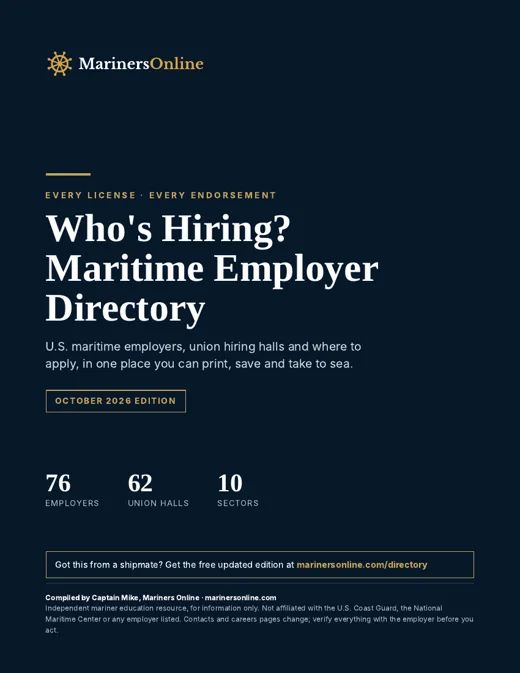 FREE DOWNLOAD · OCTOBER 2026 EDITION
Who’s Hiring? Maritime Employer Directory
76 maritime employers and 62 union hiring halls in one printable PDF: phone numbers, careers pages, a hall map and job call times. Free when you join From the Bridge, Captain Mike's monthly email: rule changes, sea-time tips and new guides, in plain English. One email a month. Unsubscribe anytime.
Sent with Kit. Your email is used only for the directory and this monthly note. See the Privacy Policy.