
Careers › Where Do You Want to Work? › Pacific & Alaska

Facts checked against Alaska state, Washington State Ferries, AMHS, NOAA, NMC and eCFR sources · October 2026
A ferry crossing Puget Sound, a tug moving an Alaska-bound barge, a fishing vessel working a seasonal opening and a research ship preparing for an extended voyage can all be part of the Pacific maritime world.
They do not offer the same job—or the same life.
The U.S. Pacific Coast and Alaska support local harbor work, ferries, fishing, seafood processing, towing, cargo transportation, research vessels, shipyards, construction and government operations.
For a newcomer, the first decision is not simply:
“Do I want to work in Alaska?”
A better question is:
“Do I want a local Pacific maritime job, a rotational job or seasonal work tied to a particular fishery or project?”
Those choices can lead to very different schedules, qualifications, travel arrangements and career paths.
And one distinction deserves attention immediately:
An Alaska maritime job is not automatically a fishing job, and a fishing-industry job is not automatically a deckhand job.
Start With Three Different Working Lives
Before worrying about licenses and endorsements, consider which working pattern sounds realistic for you.
These are starting categories, not rigid divisions. A job can be both seasonal and rotational.
Local or Shift-Based Work
Examples may include:
- Ferries.
- Harbor operations.
- Launches.
- Some workboats.
- Terminal support.
These jobs may allow you to live ashore, but do not assume that means predictable daytime work or the same reporting location every day.
Rotational or Voyage-Based Work
Examples may include:
- Tugs.
- Barge transportation.
- Cargo vessels.
- Research ships.
- Longer ferry assignments.
- Government vessels.
You may live aboard for days or weeks and report to a port some distance from home.
Seasonal or Project-Based Work
Examples may include:
- Commercial fishing.
- Seafood processing.
- Some construction work.
- Seasonal passenger work.
- Certain supply operations.
The job may exist only during a particular season or project.
“Alaska job” tells you a location.
It does not tell you your department, schedule, pay arrangement, living conditions or how you get home.
Find those answers before traveling.
From Pacific Ports to Alaska Communities
For this page, Pacific & Alaska includes maritime employment connected with:
- California’s Pacific ports.
- Oregon and Washington coastal operations.
- Puget Sound and the Salish Sea.
- Columbia and Snake River connections.
- Southeast Alaska.
- Southcentral Alaska.
- Western Alaska.
- The Aleutians.
This is a career region, not a Coast Guard credential route.
A Washington ferry deckhand, an Alaska fishing-vessel crewmember, an engineer aboard a research ship and a deckhand on an Alaska-bound tug may work within this broader region while needing different qualifications.
That is why the job should come before the credential.
Commercial Fishing: Its Own Maritime World
Fishing deserves particular attention because it is a visible part of Pacific and Alaska maritime work—and easy for newcomers to misunderstand.
Alaska’s official fishing-employment guidance emphasizes full-season availability, physical work, teamwork and following safety instructions. It also encourages prospective crewmembers to investigate job offers and understand the working conditions before accepting employment. (jobs.alaska.gov)
Not Every Fishing Job Is a Deckhand Job
Fishing-related employment can include:
- Harvesting-vessel deck work.
- Catcher-processor employment.
- At-sea seafood processing.
- Tender-vessel work.
- Engine and maintenance positions.
- Galley work.
- Shoreside seafood processing.
Those are different jobs.
A processor aboard a factory vessel may spend much of a shift handling seafood rather than fishing gear.
A harvesting-vessel deckhand may work with nets, pots, longlines, hydraulic equipment, catch handling, deck machinery and vessel maintenance. Duties vary with the fishery and vessel. (jobs.alaska.gov)
Before accepting fishing-industry work, identify the actual position and duties.
Alaska Commercial Fishing Crew Requirements
Alaska has state requirements in addition to any federal maritime requirements that apply to the vessel or position.
The Alaska Department of Fish and Game says a commercial fishing crew member license is required for direct or indirect participation in commercial fishing operations. Its guidance includes handling fishing gear and assisting with vessel maintenance, navigation, docking or operation aboard fishing vessels, tenders, processing vessels and other vessels transporting fish. (adfg.alaska.gov)
The department also identifies a processing-only exception: a person who only processes fish aboard a processing vessel does not need the crew member license.
However, if that person also performs another duty that directly or indirectly contributes to fishing operations—even briefly—the license is required under the department’s guidance. (adfg.alaska.gov)
Check the assignment rather than relying only on the job title.
Understand the Pay Agreement Before You Travel
Do not assume fishing compensation resembles an ordinary shoreside paycheck.
Ask:
- How is pay calculated?
- Is it based on hours, a daily rate, a salary, a share or another arrangement?
- What expenses may be deducted?
- When is payment made?
- Who pays transportation?
- Are food and accommodations provided?
- What happens if the season ends early?
- What happens if you leave or are discharged?
Alaska’s fishing guidance recommends obtaining a signed agreement covering compensation and other employment terms. A projected catch share is not guaranteed income. (jobs.alaska.gov)
“Good fishing money” is not a pay agreement.
Understand the calculation, deductions, payment terms and travel arrangements before leaving home.
Seafood Processing
Seafood processing deserves its own category.
Processing work may be:
- Shoreside.
- Aboard a floating processor.
- Aboard an at-sea processing vessel.
Applicants should investigate the season or contract commitment, physical duties, living arrangements, transportation and expected working hours. Alaska’s official guidance notes that processing work can involve demanding conditions and hours affected by the availability of fish. (jobs.alaska.gov)
Processing Experience and Sea-Service Credit
Do not assume that time employed aboard a processing vessel counts as deck or engine service.
Credit depends on the capacity in which you served, your duties and the requirements of the endorsement you later pursue.
Conversely, do not assume qualified deck or engine service is excluded simply because the vessel processes fish.
NMC evaluates the service performed, not just the industry label. Its guidance distinguishes qualifying deck or engine service from certain combined processing assignments. (dco.uscg.mil)
If your long-term goal is an MMC upgrade, determine what service the position may provide before assuming that months aboard equal months of qualifying deck or engine sea service.
Ferries: Transportation Careers on the Pacific
A Puget Sound commuter ferry and an Alaska Marine Highway vessel can offer very different working lives.
Both deserve investigation, but compare the actual position, reporting arrangements and schedule.
Washington State Ferries
Washington State Ferries employs people in vessel, terminal and maintenance positions.
Its employment information identifies deck, engine, licensed officer, terminal and skilled-trades opportunities. WSF also warns that entry deck employment may be on call, with varying shifts and no guaranteed hours. (wsdot.wa.gov)
That is a useful reminder:
“Local ferry job” does not automatically mean Monday through Friday, daytime hours and the same terminal every day.
For entry deck applications, WSF currently lists a TWIC, an MMC with at least the applicable OS endorsement and a valid Coast Guard Medical Certificate among its requirements. Review the current posting for the complete qualifications and hiring steps. (wsdot.wa.gov)
Do not extend one employer’s requirements to every ferry operation.
Alaska Marine Highway System
The Alaska Marine Highway System connects coastal Alaska communities and employs both shipboard and shoreside personnel. Its shipboard opportunities include vessel operations, engineering and passenger-service work. (dot.alaska.gov)
People aboard the same ferry may work in:
- Deck.
- Engine.
- Steward or passenger services.
- Licensed officer positions.
They may share a vessel while following different duties, schedules and qualification paths.
A passenger-service position is not automatically a deck position, and employment aboard a ferry does not mean every crewmember gains the same experience.
Application Requirements vs. Joining Requirements
What you need to apply may differ from what you must hold before joining the vessel.
For example, AMHS currently allows applicants to apply for an entry-level Steward position without Coast Guard credentials or maritime documents. Successful applicants must then obtain the required documents and complete applicable hiring steps before working aboard. (dot.alaska.gov)
Do not assume this arrangement applies to every AMHS position or another ferry employer.
Read the current posting and ask:
- What must I have to apply?
- What must I obtain after a conditional offer?
- What must be completed before assignment aboard?
- Does the employer help applicants through the process?
Tugs, Barges and Alaska Supply Work
Pacific–Alaska maritime transportation includes moving cargo, equipment and supplies.
Areas to investigate include:
- Harbor and ship-assist work.
- Coastal towing.
- Alaska-bound barge transportation.
- Local supply operations.
- Tank barges.
- Construction support.
- Cargo transportation.
The career questions are different from those for a local harbor job.
Ask:
- How long are the voyages?
- Where does the vessel operate?
- Where are crew changes?
- Do I live aboard?
- Is employment seasonal or year-round?
- What cargo duties will I perform?
- What route authority applies to the position?
A tug working locally around Seattle may offer a different lifestyle from a vessel moving cargo north to Alaska.
The boat may look similar from the dock.
The job may not be.
For towing officers, route qualifications matter. Coast Guard guidance and NMC checklists identify different towing routes and additional requirements for particular operations. Do not assume one route automatically authorizes another. (dco.uscg.mil)
Moving the Things Communities Need
Alaska supply operations may transport:
- Food.
- Fuel.
- Vehicles.
- Construction equipment.
- Building materials.
- Machinery.
- General freight.
The work may involve deck, engine, galley and shoreside positions.
“Alaska supply” describes what the operation accomplishes. It does not tell you what your job will be.
A terminal employee, deckhand, engineer and tug captain may support the same transportation system while following different career paths.
Before accepting an offer, identify the employer, vessel or worksite, department and duties—not just the destination.
Research Vessels: You Don’t Have to Be the Scientist
Research vessels employ professional mariners as well as scientific personnel.
NOAA, for example, operates research and survey ships staffed by NOAA Corps officers and civilian professional mariners. Its shipboard organization includes deck, engine and steward functions, along with survey and electronic technicians. (omao.noaa.gov)
Scientists may sail aboard the same vessel, but the person operating or maintaining the ship is not necessarily a scientist.
Vessel Personnel and Scientific Staff
A research voyage may involve:
- Professional vessel personnel who operate, maintain and support the ship.
- Scientists conducting the research mission.
- Technical personnel supporting instruments, surveys and data collection.
Those groups can work closely together. Professional mariners may support the deployment and operation of scientific equipment while remaining part of the vessel’s maritime workforce. (omao.noaa.gov)
Do not assume that every technician is a visiting scientist or that every scientific assignment provides the same sea-service credit as a deck or engine position.
Research-Vessel Entry Opportunities
NOAA describes recruiting skilled entry-level candidates as well as experienced professional mariners. That does not mean every position is open to someone without credentials or relevant skills. Review the particular vacancy. (omao.noaa.gov)
NOAA is also a national employer, not a guarantee of Pacific or Alaska placement. Its ships operate in U.S. waters and around the world. Confirm vessel assignment, homeport and travel expectations. (omao.noaa.gov)
For other research operators, make the same checks.
Other Pacific and Alaska Maritime Work
Other sectors worth investigating include:
- Dredging.
- Marine construction.
- Shipyards.
- Vessel repair.
- Survey operations.
- Passenger and expedition vessels.
- Government vessels.
- Port operations.
- Terminal work.
Not every good maritime career requires an MMC.
And not every maritime-related job produces qualifying vessel sea service.
If your objective is a Coast Guard endorsement, investigate the service requirements before assuming a shoreside or vessel-support assignment will satisfy them. NMC evaluates the capacity served and other service particulars for the endorsement being pursued. (dco.uscg.mil)
Choose a Department—Then Examine the Assignment
The familiar shipboard departments remain a useful starting point.
Deck
Depending on the vessel, deck duties may involve seamanship, line handling, cargo, navigation, towing or fishing operations.
Engine
Engineering work may involve propulsion, generators, electrical systems, hydraulics, pumps, maintenance and troubleshooting.
Steward, Galley and Passenger Service
Assignments may involve food preparation, provisioning, accommodations, passenger service and crew support.
Processing, Scientific and Technical Work
These are additional employment categories—not simply alternative names for deck or engine work.
Look beyond the advertisement’s phrase “work aboard a vessel.” Find out what position will be recorded and what you will actually do.
Seasonality, Distance and Getting Home
This may be the most important comparison you make.
Before accepting a Pacific or Alaska job, ask:
- Is this permanent, seasonal, relief or project work?
- What commitment is expected?
- Where do I report?
- Where does employer-provided transportation begin and end?
- What travel expenses must I pay?
- Are accommodations provided before joining?
- Who pays for lodging if joining or relief is delayed?
- What happens if weather delays crew changes?
- What happens if the vessel changes operating areas?
- What if work or the season ends early?
- What written terms govern return travel if employment ends?
- What happens after I leave the vessel?
Alaska’s fishing and seafood guidance emphasizes understanding employment terms, transportation, room and board, and season or contract commitments before accepting work. (jobs.alaska.gov)
The daily rate is only part of the offer.
Find out how long you may be away, what expenses come out of your pocket and what happens when the plan changes.
Get important terms in writing.
Weather, Remote Operations and Safety
When comparing jobs, investigate exposure to:
- Cold and wet conditions.
- Rough water.
- Long periods of daylight or darkness.
- Fishing gear and deck machinery.
- Transfers between vessels and docks.
- Fatigue.
- Remote working locations.
Do not assume every Alaska maritime job involves ice, Arctic operations or extreme isolation. Ask about the actual operating area.
Before accepting employment, ask:
- How are new people trained?
- Who supervises inexperienced workers?
- What protective equipment is supplied?
- What emergency duties will I have?
- What are the watch and rest arrangements?
- How do employees report an unsafe condition?
- How is medical care handled?
- How are crew changes managed during bad weather?
An employer’s answers can tell you a great deal.
What Credentials Do I Need?
There is no single Pacific or Alaska credential package.
Requirements depend on the:
- Vessel.
- Route.
- Position.
- Department.
- Assigned duties.
- Passenger or cargo operation.
- Employer.
You may encounter requirements involving:
- Transportation Worker Identification Credential, or TWIC.
- Merchant Mariner Credential, or MMC.
- Coast Guard Medical Certificate.
- National ratings or officer endorsements.
- STCW endorsements, when applicable.
- Towing qualifications.
- Tank-vessel qualifications.
- Alaska commercial fishing crew licensing.
- Employer training.
- Passport or border documentation relevant to the actual assignment.
This is a list of possibilities—not a checklist for every job.
Separate four things:
- National Coast Guard requirements.
- STCW requirements.
- State requirements.
- Employer requirements.
A state fishing license, a federal mariner credential and an employer training certificate serve different purposes.
Fishing Requirements
Do not assume every fishing crewmember needs an MMC.
Do not make the opposite assumption—that fishing work has no licensing, training or safety requirements.
For Alaska crew licensing, check the assigned duties against current ADF&G guidance, including its processing-only exception. (adfg.alaska.gov)
Ferry Requirements
Review the specific employer and position.
WSF’s entry deck requirements and AMHS’s entry-level Steward application process demonstrate that even public ferry employers can approach hiring differently. (wsdot.wa.gov)
STCW
U.S. regulations exempt vessels operating exclusively on the Great Lakes or U.S. inland waters from application of the STCW Convention. Other exemptions and applicability provisions also exist. (ecfr.gov)
Do not decide whether STCW applies from the words Pacific, Alaska, domestic, ferry or fishing alone.
Check the vessel, voyage, position and applicable rules before purchasing training.
Will This Job Help Me Advance?
Experience is valuable.
But experience and Coast Guard sea-service credit are not always the same thing.
NMC may need information about:
- Vessel type and tonnage.
- Propulsion and horsepower.
- Position and department.
- Duties.
- Route.
- Dates, days and hours served.
A person can gain useful work experience that does not satisfy the service requirements for a particular endorsement.
That matters when comparing fishing, processing, research, ferry and shoreside work.
A scientific or technical assignment does not automatically provide the same credit as service in the deck or engine department. Check the capacity recorded, duties and requirements of the endorsement you want.
Document Your Service
Keep your own records from the beginning.
Record:
- Vessel name.
- Official number.
- Vessel type.
- Tonnage.
- Propulsion type.
- Engine horsepower, when relevant.
- Position.
- Department.
- Dates aboard.
- Days worked.
- Hours per day.
- Route and waters operated.
- Duties performed.
Then obtain acceptable sea-service documentation from the employer or another authorized signer, as applicable. Personal notes are useful, but do not automatically replace acceptable application evidence. (dco.uscg.mil)
Ask:
- Who provides sea-service documentation?
- What position will be recorded?
- How are days and hours documented?
- Can I obtain the documentation when I leave?
Do not wait years to reconstruct your service.
Can I Start With No Experience?
Potentially.
Entry channels worth investigating include:
- Direct employer applications.
- Ferry entry-level hiring.
- Fishing recruitment.
- Seafood processing.
- Apprenticeships.
- Union training pathways.
- Deck, engine and galley openings.
- Research-vessel recruitment.
Alaska maintains resources for people exploring fishing and processing work, while NOAA describes recruitment of skilled entry-level maritime candidates. Each opportunity still has its own requirements. (jobs.alaska.gov)
“Entry level” does not mean:
“Buy a plane ticket to Alaska and figure it out when you arrive.”
Compare actual jobs first.
Confirm the employer. Confirm where you report. Confirm travel. Confirm the employment terms.
Then spend money.
A Practical Pacific & Alaska Starting Plan
1. Choose Your Working Pattern
Do you want:
- Local work?
- A rotational job?
- Seasonal employment?
- Longer voyages?
Start with the lifestyle you can realistically accept.
2. Choose a Sector
Compare:
- Ferries.
- Fishing.
- Seafood processing.
- Towing.
- Cargo transportation.
- Research vessels.
- Passenger work.
- Government operations.
3. Identify the Actual Job
“Work in Alaska” is not specific enough.
Find the position, department and duties.
4. Compare Current Employer Requirements
Check credentials, experience, training, schedule, reporting location and advancement opportunities.
Distinguish what is required to apply from what is required before joining.
5. Understand the Employment Terms
Use the travel and employment checklist above.
For seasonal work, pay particular attention to compensation, deductions, the expected commitment and what happens if the work ends early.
6. Obtain the Qualifications You Need
Do not buy training merely because it sounds useful.
Confirm that it is required by the job or supports a defined credential goal.
7. Get Aboard and Keep Records
Learn the assignment.
Build a reputation.
Obtain service documentation while the employer and people who can verify your work are easy to reach.
8. Reassess
After gaining experience, ask:
“Do I want more of this—or a different part of the industry?”
That answer will be better informed after your first job than before it.
Is Pacific & Alaska Work Right for You?
This region deserves investigation if you are interested in:
- Fishing and seafood work.
- Ferries.
- Coastal towing.
- Cargo transportation.
- Research vessels.
- Government operations.
- Seasonal maritime employment.
- Rotational schedules.
- Regional transportation.
Compare the opportunities against:
- Seasonal uncertainty.
- Travel costs.
- Time away.
- Shared living arrangements.
- Physical duties.
- Weather.
- Reporting locations.
- Transportation home.
Do not choose the job because the mountains look good in the photograph.
Choose the work you can live with.
The Bottom Line
Pacific and Alaska maritime careers are about more than working on the West Coast.
They include moving passengers, harvesting and processing seafood, delivering cargo, operating ferries, towing barges, supporting research and keeping vessels working across a large and varied region.
Start with three questions:
- Do I want local, rotational or seasonal work?
- Which vessel and position fit me?
- What do actual employers require before hiring and before joining?
Then work backward.
Your Next Step
- New to maritime work? Start with Get Your First Maritime Job.
- Want local vessel work? Read Coasts & Harbors Maritime Careers.
- Interested in towing? Explore Tugboats, Towboats & Barges.
- Interested in fishing or seafood? Compare vessel duties with processing work before applying. See our fishing & processing employer directory.
- Interested in ferries? Review current ferry-employer requirements before buying training.
- Interested in research ships? Look at professional-mariner and technical vacancies—not only scientific positions. See our research vessel employers.
- Already aboard? Review Documenting Sea Service before another hitch goes by.
Who’s Hiring: Pacific & Alaska
Our directories list fishing and processing, ferry, towing and research employers with links to their own careers pages. The Who’s Hiring quick list can also show only West Coast or Alaska employers.
Fishing & processing employers → West Coast employers → Alaska & Hawaii employers → Research vessel employers →Do not choose Alaska because a photograph makes the job look adventurous.
A ferry, fishing vessel, cargo barge and research ship offer different working lives.
Find out:
- What you will do.
- How you will be paid.
- Where you will report.
- How long you will be gone.
- How you will get home.
Then decide whether the opportunity fits you.
Official Sources
- Alaska Department of Labor and Workforce Development — Fishing Vessel Jobs and guidance for prospective fishing crewmembers (PDF).
- Alaska Department of Labor and Workforce Development — Seafood-processing employment and working conditions.
- Alaska Department of Fish and Game — Commercial Fishing Crew Member License requirements and processing-only exception.
- Washington State Ferries — Employment, entry deck requirements and hiring conditions.
- Alaska Marine Highway System — Employment and entry-level Steward application guidance.
- NOAA Office of Marine and Aviation Operations — Shipboard departments and professional-mariner recruitment.
- U.S. Coast Guard National Maritime Center — Sea-service documentation and crediting guidance and 12-hour day / time-and-a-half credit.
- Electronic Code of Federal Regulations — 46 CFR 15.1101, STCW applicability and exemptions.
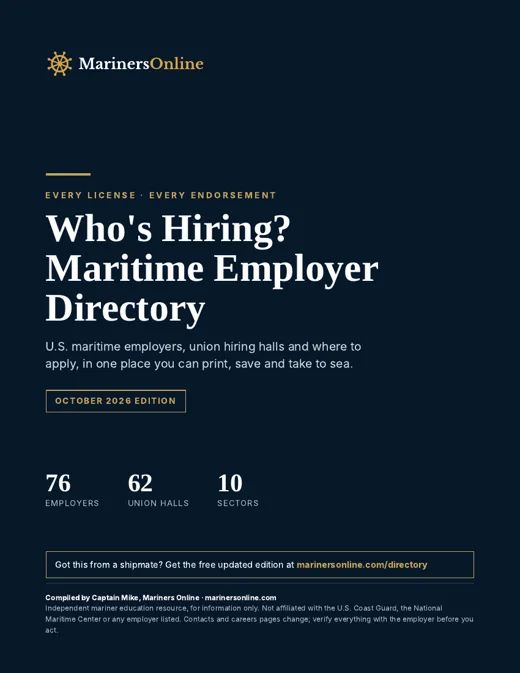 FREE DOWNLOAD · OCTOBER 2026 EDITION
Who’s Hiring? Maritime Employer Directory
76 maritime employers and 62 union hiring halls in one printable PDF: phone numbers, careers pages, a hall map and job call times. Free when you join From the Bridge, Captain Mike's monthly email: rule changes, sea-time tips and new guides, in plain English. One email a month. Unsubscribe anytime.
Sent with Kit. Your email is used only for the directory and this monthly note. See the Privacy Policy.