
Careers › Where Do You Want to Work? › Great Lakes

Facts checked against Seaway, Transport Canada, eCFR and Coast Guard sources · October 2026
When people picture a merchant mariner, they often imagine an oceangoing ship headed across the Atlantic or Pacific.
That leaves out one of North America’s major commercial maritime regions.
The Great Lakes–St. Lawrence Seaway System stretches roughly 2,300 miles from the Atlantic Ocean into the industrial and agricultural heart of North America. It connects the St. Lawrence River with Lakes Ontario, Erie, Huron, Michigan and Superior and serves more than 100 ports and commercial docks in the United States and Canada.
For someone considering a maritime career, that means something important:
You can build a serious career aboard commercial vessels without spending your working life crossing oceans.
Great Lakes mariners work aboard large bulk carriers, self-unloaders, tug-and-barge units, tank vessels, ferries, dredges, research vessels and other commercial craft.
Jobs range from entry-level deck, engine and galley positions to licensed mates, masters and engineers, along with a wide variety of shoreside maritime work.
First: What Is a Laker?
A Laker is a vessel built or operated primarily for trade within the Great Lakes system.
Many are bulk carriers hauling commodities such as iron ore, limestone, salt, coal, grain, cement and other bulk materials.
Many Lakers are also self-unloading vessels.
Instead of depending entirely on shoreside cranes, the vessel carries conveyor equipment and an unloading boom that can move bulk cargo from the cargo holds directly onto a dock.
If you see a Great Lakes freighter with a long boom folded along its deck, there is a good chance you are looking at a self-unloader.
The Great Lakes–St. Lawrence Seaway System describes three broad groups of commercial vessels using the system:
Lakers
Vessels operating primarily within the Great Lakes and Seaway system.
Salties
Oceangoing vessels that enter the Lakes through the St. Lawrence Seaway.
Tug-propelled barges
Tug-and-barge combinations carrying a variety of cargoes.
That is the first thing to understand about Great Lakes shipping:
It is not one fleet doing one kind of work.
Some Great Lakes Ships Are Very Large
Some U.S. Lakers are more than 1,000 feet long.
The largest vessels are too large to transit the Welland Canal and remain on the upper Great Lakes. A federal Great Lakes–St. Lawrence Seaway study describes 1,000-foot Lakers as limited to the Lakes above the Welland Canal because of their size.
By comparison, the Seaway’s published maximum vessel dimensions are approximately 740 feet in length and 78 feet in beam, subject to applicable draft, height and other transit requirements.
That gives the Lakes an unusual mixture of vessels:
Lakers, foreign-going Salties, tugs, barges, ferries, dredges, government vessels and research ships may all operate within the same broader transportation system.
So saying:
“I want to work on the Great Lakes”
is only the beginning.
The next question is:
What kind of vessel and what kind of work?
Deck Department
A new deck mariner may begin as an Ordinary Seafarer, commonly still referred to around the industry as an OS.
With qualifying sea service, training, examinations and the required endorsements, a deck mariner may later advance into Able Seafarer ratings and eventually licensed officer positions.
A simplified career path might look like:
That is an illustration, not an automatic promotion ladder. Every endorsement has its own service, examination and qualification requirements.
The Coast Guard now officially uses Ordinary Seafarer and Able Seafarer for these national ratings. The older terms Ordinary Seaman and Able Seaman remain common in everyday industry conversation, so newcomers are likely to hear both. Under current regulations, an Able Seafarer is a rating above Ordinary Seafarer, and several Able Seafarer categories exist.
Deck work on Great Lakes vessels may include mooring and unmooring, anchoring, steering, lookout duties, watchstanding, maintenance, cargo work, safety equipment, lock transits, docking and undocking.
Great Lakes vessels may also make frequent port calls compared with ships spending long periods crossing an ocean.
That can mean plenty of practical work around docks, locks, lines and cargo operations.
If you like working outside, operating vessels, seamanship and eventually navigation and shiphandling, the deck department deserves a serious look.
Engine Department
Large Great Lakes vessels have substantial machinery plants.
A new engine-room mariner may begin as a Wiper and eventually qualify for endorsements as a Qualified Member of the Engine Department (QMED) before moving toward licensed engineering positions.
A simplified progression might look like:
Again, this is an illustrative career path, not an automatic progression or the only route.
The endorsement required depends on the vessel, propulsion machinery, horsepower and other factors, and advancement requires meeting applicable service, examination and other requirements.
Engine personnel may work with main propulsion machinery, generators, pumps, electrical systems, hydraulics, fuel systems, auxiliary machinery, heating and cooling equipment, cargo machinery and self-unloading systems.
A self-unloading Laker contains a considerable amount of machinery beyond the engines that turn the propeller.
For someone who likes engines, electrical systems, troubleshooting, hydraulics and repair work, a Great Lakes engineering career can offer plenty of it.
Steward and Galley Department
Larger vessels may also carry steward or galley personnel.
Positions can include cooks, chief cooks, stewards, galley utilities and other food-service positions.
These mariners prepare meals, maintain food stores and help keep crew living areas functioning.
The galley may not get the photographs that the bridge and engine room get, but crews living aboard for weeks at a time know exactly how important a good one is.
If cooking, food service and crew support fit your skills, this can be another route into commercial maritime employment.
Tugs and Barges on the Great Lakes
Not every Great Lakes mariner works aboard a 700- or 1,000-foot freighter.
Tugs and tug-barge combinations are an important part of the system and may be involved in cargo transportation, harbor work, ship assist, towing, tank-barge operations, dredging support, construction support and other marine services.
For a newcomer, tug and barge work can provide a very different career from sailing aboard a traditional large ship.
- Crews may be smaller.
- The work may be more hands-on.
- Schedules may be different.
Credential requirements can also vary considerably depending on the vessel, route and position.
Do not assume the largest ship offers the best career.
A tug, ferry or other smaller commercial vessel may be a better doorway into the industry depending on where you live, what kind of work interests you and how you want your schedule to look.
What About Ferries?
Ferries offer another type of Great Lakes employment worth investigating.
Some ferry operations carry passengers, vehicles or both. Jobs may involve deck, engine, customer-service and other vessel duties depending on the operation.
When comparing ferry jobs, ask about the vessel’s route, operating season, department, daily schedule and whether the position involves living aboard or reporting for individual shifts.
Do not assume every ferry job has the same credential requirements.
And do not assume every ferry job gets you home every night.
What Are Salties?
The Great Lakes connect to the Atlantic through the St. Lawrence Seaway.
That allows oceangoing vessels to move between foreign ports and Great Lakes ports.
These vessels are commonly called Salties.
So you may see a U.S. Laker that spends its working life within the Lakes tied up near an oceangoing vessel that recently arrived from overseas.
That mixture of domestic and international shipping is one of the things that makes the Great Lakes maritime world distinctive.
What Do Great Lakes Ships Carry?
Great Lakes shipping is closely tied to North American agriculture, manufacturing, construction and heavy industry.
Major cargoes include iron ore, limestone, coal, salt, grain, steel products, cement, machinery and other bulk and general cargo.
Why should a new mariner care about cargo?
Because cargo helps determine where the vessel sails, how often it enters port, what kind of loading and unloading equipment it carries and what kind of work the crew performs.
Understanding the vessel’s trade helps you understand the job.
Great Lakes Work Is Not “Easy Water”
Do not let the word lake fool you.
The Great Lakes are enormous bodies of water.
Mariners may encounter strong winds, heavy seas, fog, snow, ice, cold temperatures, narrow channels, confined waterways, locks, bridges, commercial traffic and frequent maneuvering.
The Lakes may be freshwater.
They are still serious commercial waters.
A mariner who assumes otherwise may eventually receive a fairly direct lesson from the weather.
No tuition required.
Locks Are Part of Great Lakes Shipping
Moving through the full Great Lakes–St. Lawrence system can involve the Soo Locks, the Welland Canal locks, and the Montreal–Lake Ontario section of the St. Lawrence Seaway.
Which locks a vessel uses depends on its route.
The Welland Canal connects Lake Erie and Lake Ontario, bypassing Niagara Falls. The Montreal–Lake Ontario section contains seven locks, while the Welland Canal contains eight. The Soo Locks provide the connection around the St. Marys River rapids between Lake Superior and the lower Lakes.
For deck personnel, lock operations can mean close-quarters maneuvering, line handling, communications and careful situational awareness.
Those are very different working conditions from spending ten days in the middle of an ocean with nothing nearby but water.
Is Great Lakes Shipping Seasonal?
There is a strong seasonal component to Great Lakes shipping.
Ice conditions, lock operations and scheduled maintenance affect portions of the system.
The exact sailing season depends on the route, vessel and employer, and operating dates can change from year to year.
That means someone considering a Great Lakes employer should ask practical questions before accepting the job:
- How long is the normal sailing season?
- What happens during winter layup?
- Are crewmembers retained during layup?
- Is maintenance work available?
- How are vacation and relief handled?
- What is the normal work rotation?
- Is the position permanent or seasonal?
- Do crewmembers normally return to the same vessel?
Those answers may vary significantly between companies.
Do not assume “Great Lakes shipping” describes one work schedule.
What Is Winter Layup?
Some Great Lakes vessels spend part of the winter out of active navigation.
That period may be used for inspection, overhaul, repairs and maintenance.
Depending on the vessel and employer, layup work may involve engine overhauls, machinery repairs, steel work, painting, cargo-system maintenance, electrical work, inspections and shipyard projects.
For engineering and maintenance-minded mariners, layup work can provide experience that may be very different from normal sailing operations.
But ask the employer how its particular system works.
Do not assume winter automatically means either months of paid work or months sitting at home.
And do not assume every day employed during a layup or shipyard period automatically qualifies as sea service toward a Coast Guard endorsement.
What Credentials Do I Need?
The credential guidance here focuses on U.S. Coast Guard requirements.
Canadian employment and foreign-flag employment may involve different national credentialing and employment requirements.
There is no single license required of everyone working on the Great Lakes.
The credential or endorsement you need depends on the vessel, route, position and duties.
Depending on the job, you may encounter national endorsements with route limitations involving areas such as:
- Inland
- Great Lakes and Inland
- Near Coastal
- Oceans
Do not choose an endorsement merely because its title sounds like the water where you want to work.
Choose the vessel and job first. Then determine what credential that job requires.
That can save considerable time and money.
Use the current National Maritime Center checklist for the actual endorsement or rating you are pursuing rather than relying on an old school brochure, an employer advertisement from years ago or advice from somebody who last renewed his license when fax machines were impressive technology.
Do I Need STCW?
Not automatically.
Under current U.S. regulations, vessels operating exclusively on the Great Lakes are exempt from application of the STCW Convention. The same regulation also identifies certain other exempt waters and vessel categories.
That does not eliminate applicable national credential, medical, safety or employer requirements.
If the vessel operates outside the Great Lakes, or you are preparing for another type of employment, check the requirements for that vessel, route and position.
Do not automatically purchase STCW training simply because someone tells you:
“You’ll need it if you want to work on ships.”
First identify the employment you are pursuing.
Then determine the actual requirements for that position.
What About Great Lakes Pilots?
You may also hear about Great Lakes pilots.
Pilotage is a specialized profession involving experienced mariners providing local navigation expertise to vessels subject to Great Lakes pilotage requirements.
The Coast Guard maintains a dedicated Great Lakes Pilotage Division and regulates U.S. registered Great Lakes pilots.
This is not an entry-level job.
A beginner should not confuse becoming a Great Lakes pilot with simply obtaining an ordinary deck-officer endorsement.
Pilotage belongs much farther down the road.
For now:
Get aboard. Learn the industry. Build sea service. Advance.
Where Are Great Lakes Maritime Jobs?
On the U.S. side, Great Lakes maritime activity reaches Minnesota, Wisconsin, Illinois, Indiana, Michigan, Ohio, Pennsylvania and New York.
The larger system also includes major Canadian maritime activity in Ontario and Quebec.
The Great Lakes–St. Lawrence system serves more than 100 ports and commercial docks across the region.
Employers and work areas include vessel operators, tug companies, ferry companies, shipyards, marine pilots, stevedores, terminals, dredging contractors, port operations, vessel agencies and other marine-support businesses.
Not every job around a port is a merchant mariner position.
Shoreside jobs may have completely different qualification requirements, and shoreside employment should not automatically be assumed to provide qualifying vessel sea service.
For a career mariner, however, this broader maritime industry matters.
Experience aboard vessels can eventually open doors ashore.
Can I Start on the Great Lakes With No Experience?
Potentially, yes.
Whether an employer hires inexperienced mariners depends on the company, vessel and position.
A U.S. entry-level applicant may encounter requirements involving some combination of a Transportation Worker Identification Credential (TWIC), Merchant Mariner Credential (MMC), Coast Guard Medical Certificate, drug-testing requirements, entry-level ratings and employer-required training.
Do not assume every Great Lakes job requires exactly the same package.
And do not begin by buying every maritime class you can find.
A better approach is:
Find the type of job you want, identify employers doing that work, and then determine what the employer and Coast Guard actually require.
A Practical Starting Plan
Start by deciding which department fits you.
Deck
Deck may appeal if you like working outside, vessel operations, navigation, seamanship, line handling and cargo work.
Engine
Engine may appeal if you like machinery, engines, electrical systems, hydraulics, repair work and troubleshooting.
Steward / galley
Steward or galley may fit if your strengths are cooking, food service, provisioning and supporting a crew.
Then decide what kind of vessel interests you.
A Great Lakes career might put you aboard a large Laker, tugboat, tug-barge unit, ferry, dredge, tank vessel, research vessel or government vessel.
Next, look at actual employers.
Pay attention to the credentials they require, work schedules, hiring locations, whether employment is union or nonunion, transportation arrangements, seasonal considerations and whether they hire entry-level mariners.
Only after you understand the job should you spend money on training and credentials.
Get Aboard and Start Building Experience
Your first maritime job does not have to be your final one.
The immediate objective is to begin building:
Experience. Skills. Contacts. Reputation. Sea service.
That first job is your doorway into the industry.
What matters next is what you do with it.
Document Your Sea Service From Day One
Do not wait several years and then try to reconstruct your career from old pay stubs and memory.
Keep your own record of the vessel name, official number, vessel type, tonnage, position served, dates aboard, days worked, waters operated, duties performed and hours worked per day.
For engine service, keep propulsion type and horsepower information when applicable.
But understand the difference between personal records and official application evidence.
Your own notes are extremely useful for checking your records, but they do not necessarily replace the documentation the National Maritime Center requires.
Obtain properly completed sea-service documentation from the employer, vessel owner, master or other authorized signer as applicable. The National Maritime Center provides Form CG-719S for documenting small-vessel sea service and accepts appropriate documented sea service as part of credential applications.
Do not assume every day on payroll — including time during winter layup or shipyard work — automatically counts as qualifying sea service for the endorsement you want.
Check the requirements for that endorsement.
Sea service is too valuable to leave to memory.
Keep your own records and get the proper documentation while the people who can sign it still know who you are.
What Can a Great Lakes Career Lead To?
A first Great Lakes job can be the beginning rather than the destination.
Deck mariners may move into higher ratings, towing, tank-vessel work, officer endorsements, vessel management or other operational positions.
Engine mariners may advance through QMED ratings and licensed engineering positions.
Other opportunities can develop in ferries, towing, dredging, shipyards, surveying, port operations, vessel management, pilotage and other shoreside maritime work.
Your career does not have to follow one ladder forever.
Maritime experience travels surprisingly well.
Is Great Lakes Shipping Right for You?
Great Lakes work deserves a serious look if you are interested in commercial-vessel experience, bulk shipping, tug-and-barge work, engineering, frequent port operations or a maritime career based around the central and eastern United States.
But there is no single “Great Lakes lifestyle.”
Working aboard a thousand-foot bulk carrier is very different from working aboard a harbor tug.
A ferry can be different from both.
So do not choose a career simply because you like the region.
Look at the entire package:
Vessel + job + employer + schedule + advancement opportunity.
The Bottom Line
Great Lakes shipping is easy for newcomers to overlook because it does not fit the usual picture of the Merchant Marine.
That would be a mistake.
The Great Lakes–St. Lawrence system includes enormous commercial ships, oceangoing vessels, tugs, barges, ferries, ports, shipyards and a wide range of maritime careers.
You do not need to understand every credential before exploring it.
Start with three questions:
- What department interests me?
- What type of vessel interests me?
- Which employers operate those vessels?
Then work backward and obtain the qualifications the job actually requires.
Your Next Step
- If you are completely new to the industry, continue with Get Your First Maritime Job.
- If you are unsure which department fits you, read Deck vs. Engine vs. Steward.
- If smaller crews and towing interest you, explore Tugboats, Towboats & Barges.
- If machinery interests you, explore the Engine Career Path.
- If you are already working, review Documenting Sea Service before another year goes by.
Who’s Hiring: Great Lakes
Our full Great Lakes employer directory is still being built. In the meantime, the Who’s Hiring quick list shows the Great Lakes employers we have checked so far, with links to their own careers pages.
Great Lakes employers (quick list) →Don’t overlook the Lakes because they aren’t an ocean.
You can work aboard everything from a harbor tug to a thousand-foot bulk carrier.
Don’t start by collecting credentials.
Start with the job you want, find companies doing that work, and then get the qualifications that move you aboard.
Official Sources
- Great Lakes–St. Lawrence Seaway System: Locks, Canals & Channels — locks in the Montreal–Lake Ontario section and Welland Canal; maximum vessel dimensions.
- Great Lakes–St. Lawrence Seaway System: Seaway poster (PDF) — Lakers, Salties and tug-propelled barges.
- Great Lakes St. Lawrence Seaway Development Corporation (U.S. DOT): Seaway Fact Sheet (PDF) — U.S. Seaway information, locks, vessels and commodities.
- Great Lakes St. Lawrence Seaway Study, Final Report, Fall 2007 (PDF) — 1,000-foot Lakers limited to the Lakes above the Welland Canal.
- Transport Canada (March 2024) — system length (3,700 km) and more than 100 ports and commercial docks.
- eCFR, 46 CFR 15.1101 — STCW applicability and Great Lakes exemption.
- eCFR, 46 CFR 12.401 — current Able Seafarer terminology and categories.
- U.S. Coast Guard National Maritime Center — Merchant Mariner Credential applications, forms and current credential information. NMC checklists · Form CG-719S (PDF).
- U.S. Coast Guard Great Lakes Pilotage Division — Great Lakes pilotage regulations and program information.
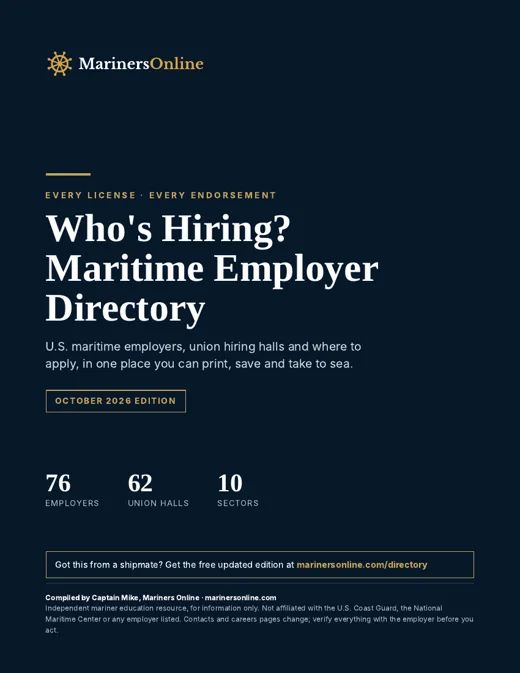 FREE DOWNLOAD · OCTOBER 2026 EDITION
Who’s Hiring? Maritime Employer Directory
76 maritime employers and 62 union hiring halls in one printable PDF: phone numbers, careers pages, a hall map and job call times. Free when you join From the Bridge, Captain Mike's monthly email: rule changes, sea-time tips and new guides, in plain English. One email a month. Unsubscribe anytime.
Sent with Kit. Your email is used only for the directory and this monthly note. See the Privacy Policy.