
Careers › Where Do You Want to Work? › Gulf Coast

Facts checked against MARAD, eCFR, Coast Guard, NMC and Nautical Institute sources · October 2026
When people hear Gulf Coast maritime work, many picture an oil rig.
That is only part of the story.
The Gulf Coast supports offshore supply vessels, crew boats, tugs, barges, tankers, dredges, construction vessels, ferries, ports, shipyards and a large amount of inland and coastal towing.
MARAD’s Central Gulf & Southern Rivers Gateway profile describes a maritime region centered on Alabama, Louisiana and Mississippi. It connects lower Mississippi commerce, Gulf Intracoastal Waterway traffic, offshore oil and gas support, ports, LNG terminals and shipyards. MARAD reports more than 50 operating coastal and inland ports and more than 100 ship and boat construction and repair facilities within that region alone. (maritime.dot.gov)
For a newcomer, that means something important:
“Working the Gulf” is not one career. It is a collection of different maritime careers operating in the same broader region.
You might work aboard a small crew boat, a harbor tug, a tank barge, a large offshore supply vessel, a dredge, a tanker or a construction vessel.
The first question is not simply:
“How do I get an offshore job?”
It is:
“What kind of Gulf maritime work do I actually want?”
What Does “The Gulf” Mean Here?
For this page, the Gulf means the U.S. Gulf Coast maritime region and the waters connected to it.
That includes maritime activity in and around:
- Texas
- Louisiana
- Mississippi
- Alabama
- Florida’s Gulf Coast
- The lower Mississippi River
- The Gulf Intracoastal Waterway
- Offshore Gulf waters
- Major ports and industrial waterways
These areas overlap.
A towing company may work rivers, protected waterways and coastal waters. An offshore company may move vessels between ports, offshore facilities and shipyards.
Your job may therefore cross more than one neat category.
This is a career region—not a single Coast Guard credential route.
What Kinds of Vessels Work the Gulf?
The Gulf supports a wide mix of commercial vessels, including:
- Offshore supply vessels
- Platform supply vessels
- Crew boats
- Fast supply vessels
- Tugs and towboats
- Articulated tug-barge units
- Tank barges
- Dredges
- Construction vessels
- Liftboats
- Dive-support vessels
- Research vessels
- Tankers
- LNG carriers and supporting vessels
- Ferries and passenger vessels
- Harbor and terminal vessels
Some descriptions overlap. A platform supply vessel may also be described as an OSV.
Other terms describe equipment or capability rather than a separate vessel type. Dynamic positioning, for example, is a system installed aboard a vessel—not a separate category of ship. (dco.uscg.mil)
A person interested in machinery may have a very different Gulf career from someone pursuing towing, cargo-transfer work or bridge operations.
Offshore Supply Vessels
One of the most recognizable Gulf vessel types is the offshore supply vessel, usually shortened to OSV.
U.S.-flag OSVs are subject to Coast Guard inspection and operating requirements. Many are inspected under 46 CFR Subchapter L; the requirements that apply depend on the vessel and its certification. (ecfr.gov)
These vessels support offshore operations by transporting personnel, equipment, provisions and other authorized cargoes between shore bases and offshore facilities.
Depending on the vessel and operation, cargo may include:
- Pipe
- Drilling supplies
- Fuel
- Water
- Cement
- Drilling mud and related materials
- Food and provisions
- Equipment
- Offshore workers
Some vessels have large open aft decks for carrying supplies and equipment. Others are highly specialized.
For a newcomer, OSV is not a job title.
It describes a vessel category containing different departments, assignments and career paths.
Deck Careers on Offshore Vessels
Depending on their position, qualifications and assigned duties, deck personnel may be involved with:
- Navigation
- Watchstanding
- Mooring
- Cargo operations
- Deck maintenance
- Crane and lifting support
- Safety equipment
- Approaches to offshore facilities
- Personnel or equipment transfers
- Dynamic-positioning operations
Entry points vary by vessel and employer.
Some people enter through unlicensed deck positions and build experience. Others enter through a maritime academy or another officer pathway.
A simplified career illustration might look like:
But an important distinction belongs here.
National ratings and STCW endorsements are separate qualifications.
Current National Maritime Center materials distinguish the national Able Seafarer ratings—the endorsements formerly called Able Seaman—from the international Able Seafarer–Deck STCW endorsement. (dco.uscg.mil)
Where applicable, additional STCW watchkeeping qualifications may also be required.
The progression above is illustrative, not an automatic promotion sequence or the only route. Advancement depends on applicable sea service, assessments, training, examinations, vessel limitations and other requirements.
Engine Careers on Offshore Vessels
Offshore vessels can be machinery-intensive.
Engineering personnel may work with:
- Main propulsion engines
- Generators
- Electrical systems
- Thrusters
- Hydraulic systems
- Pumps
- Fuel systems
- Cargo pumps
- Refrigeration
- Power-management equipment
- Auxiliary machinery
DP-equipped vessels also depend on coordinated power, control and thruster systems to maintain position and heading.
That gives the people maintaining the equipment an important role—not just the officers operating the DP system from the bridge. (dco.uscg.mil)
A simplified engineering path might look like:
Again, this is an illustration, not an automatic sequence.
Qualifications depend on the vessel, machinery, position and endorsement being pursued.
For someone who enjoys engines, electrical systems, hydraulics and troubleshooting, Gulf offshore vessels are a sector worth investigating.
What Is Dynamic Positioning?
You will hear the term dynamic positioning, or DP, frequently in offshore work.
A DP system uses computerized controls, position-reference systems, sensors and propulsion or thrusters to automatically maintain a vessel’s position and heading without relying on conventional anchoring or mooring. (dco.uscg.mil)
That capability is useful when a vessel is working near:
- Offshore platforms
- Drilling rigs
- Subsea equipment
- Construction sites
- Dive operations
How DPO Qualifications Fit Into a Career
A Dynamic Positioning Operator, or DPO, works in a specialized area of vessel operations.
DPO certification is separate from a Coast Guard officer endorsement.
A Coast Guard credential does not automatically provide DPO certification, and a DPO certificate does not replace whatever Coast Guard credential the position itself requires.
Certification schemes have their own eligibility, approved training, onboard experience, assessment and sign-off requirements. The Nautical Institute administers one widely used DP certification scheme. (nautinst.org)
For someone aiming to work as a bridge DPO, an appropriate deck-officer pathway is a practical starting point.
But do not turn that into a blanket rule that everyone must already hold a final officer qualification before beginning DP training. Current scheme eligibility also addresses certain officer trainees and other qualifying maritime backgrounds.
Before paying for a DP course, confirm:
- Whether you meet the scheme’s entry requirements
- Which certification scheme the employer accepts
- How you will obtain qualifying onboard DP experience
- What assessments and sign-offs will be required
DP training is not a shortcut around the underlying qualifications needed for the job.
Crew Boats and Fast Supply Vessels
Not all Gulf offshore work happens aboard large OSVs.
Crew boats and fast supply vessels transport personnel, supplies and equipment between shore bases and offshore facilities.
Depending on the operation, the work may involve:
- Smaller crews
- Frequent departures and arrivals
- Offshore transfers
- Shorter turnaround periods
- Different staffing and credential requirements from larger vessels
For someone interested in smaller commercial vessels, this part of the Gulf industry deserves attention.
Do not assume that “offshore” means living aboard a giant vessel for months.
But do not assume a smaller boat means day work or going home every night, either.
Ask about the vessel’s actual operating pattern, accommodations and crew rotation.
Tugs, Towboats and Barges
The Gulf Coast is also a major towing region.
MARAD’s Central Gulf profile identifies extensive Gulf Intracoastal Waterway barge traffic, including petroleum and petrochemical movements. (maritime.dot.gov)
Gulf towing work can involve:
- Harbor tugs
- Ship assist
- Coastal towing
- Tank barges
- Dry-cargo barges
- Offshore towing
- Construction barges
- Articulated tug-barge units
- Gulf Intracoastal Waterway operations
Some mariners move between inland and Gulf towing during their careers.
That makes route authority important.
Do not assume that a towing qualification valid for one route automatically authorizes every other operation. Coast Guard towing guidance and NMC checklists distinguish route-specific qualifications and requirements. (dco.uscg.mil)
What Is an ATB?
An articulated tug-barge, usually called an ATB, uses a mechanical connection between a tug and a barge, usually with the tug positioned in a notch at the barge’s stern.
The units operate together while remaining distinct tug and barge components.
A newcomer interested in towing should compare:
- Inland towboats
- Harbor tugs
- Coastal tugs
- ATBs
- Offshore towing
These are related careers, but they are not identical.
Working on an ATB does not create one universal credential package.
Wheelhouse authority, machinery staffing and cargo-transfer qualifications have to be considered separately for the unit and position.
Do not assume service aboard an ATB will be treated exactly like service aboard a conventional ship for every credential purpose. The Coast Guard has specific policies concerning service credit on articulated tug-barge combinations. (dco.uscg.mil)
Tank Barges and Petroleum Work
The Gulf Coast supports extensive petroleum and chemical transportation.
That creates work aboard tank barges, tankers, ATBs and other vessels authorized to carry particular liquid cargoes.
But these are not all the same assignment:
- Working aboard a tank vessel
- Assisting with cargo operations
- Serving as the Person in Charge of a cargo transfer
carry different responsibilities.
PIC means Person in Charge.
Current Coast Guard endorsement titles include:
- Tank Vessel-PIC
- Tank Barge-PIC
- Restricted PIC endorsements
- Tank Vessel-Assistant
- Tank Vessel-Engineer
The qualifications depend on the endorsement, cargo and duties and may include approved training, qualifying sea service and documented cargo transfers. (dco.uscg.mil)
Holding an MMC does not by itself qualify a mariner to supervise every cargo transfer.
Some OSV liquid-cargo operations also have specific requirements for personnel involved in transfers.
Check the vessel’s authorized cargoes, Certificate of Inspection and the duties actually assigned rather than assuming every OSV requires the same tank-vessel endorsement.
Never buy a tank-vessel course simply because you see a lot of tank barges in Louisiana or Texas.
First determine the job, the cargo duties and the qualification those duties require.
Dredging and Marine Construction
Dredging is another Gulf career newcomers often overlook.
Dredges and supporting vessels help:
- Maintain navigation channels
- Deepen ports
- Build or restore shorelines
- Support coastal projects
- Move dredged material
- Support marine construction
Work may exist aboard:
- Hopper dredges
- Cutter suction dredges
- Tugs
- Workboats
- Survey boats
- Crane barges
- Material barges
- Support vessels
Marine construction may also involve:
- Pile driving
- Dock construction
- Bridge work
- Offshore construction
- Pipeline projects
- Salvage
- Heavy-lift operations
For someone interested in commercial-vessel work but not ocean crossings, dredging and marine construction deserve a serious look.
Ask whether the position is shipboard, shoreside or a combination and what qualifications apply to the actual assignment.
Offshore Energy Is Bigger Than Working on a Rig
Oil and natural-gas activity is an important part of the Gulf’s maritime economy.
MARAD identifies offshore exploration and production as a generator of regional maritime work involving supply vessels, crew boats, offshore tugs and specialized barges. (maritime.dot.gov)
Maritime jobs may support:
- Exploration
- Drilling
- Production
- Subsea operations
- Platform maintenance
- Pipeline work
- Crew transportation
- Cargo delivery
- Inspection
- Construction
- Emergency response
A person can build a Gulf maritime career supporting offshore energy without being a drilling-rig employee.
When evaluating newer or emerging opportunities, look for actual projects, vessel assignments and current employer hiring—not headlines alone.
Before buying specialized training, confirm that employers are recruiting for the work and that the qualification fits the position you want.
Ports and Terminals
Port-related maritime work can include:
- Tug and launch operations
- Mooring services
- Tanker support
- Bunkering
- Terminal operations
- Shipyards
- Dredging
- Vessel agencies
- Pilot services
- Cargo operations
Not every job in a port is a merchant-mariner job.
A shoreside terminal position may be an excellent maritime career, but it should not automatically be assumed to provide qualifying vessel sea service.
The National Maritime Center evaluates the vessel, position, duties and other service particulars when determining credit toward an endorsement. (dco.uscg.mil)
The Gulf Intracoastal Waterway
The Gulf Intracoastal Waterway, or GIWW, links ports, terminals and industrial areas and supports extensive towing and barge traffic.
Depending on the route, a mariner may encounter:
- Towboats and tugs
- Tank barges
- Dry-cargo barges
- Bridges
- Locks
- Industrial canals
- Busy ports
- Connections with other waterways and coastal operations
The GIWW demonstrates why Gulf and river careers overlap.
A company may conduct inland, intracoastal and coastal work, but its operating area is not a substitute for checking your own qualifications and route authority.
Weather Matters
Gulf maritime work brings environmental challenges.
Crews may encounter:
- Heat
- Humidity
- Thunderstorms
- Fog
- Strong currents
- Heavy rain
- Tropical storms
- Hurricanes
Weather can affect vessel movements, offshore operations, ports and crew changes.
Before accepting a position, ask how the employer communicates storm-related changes and handles travel, delayed reliefs and interruptions to operations.
Understanding the job includes understanding what happens when the normal schedule cannot be followed.
What Are the Work Schedules Like?
There is no single Gulf maritime schedule.
Depending on the vessel and company, work may involve:
- Multiweek rotations
- Equal-time schedules
- Unequal rotations
- Day work
- Harbor shifts
- Trip assignments
- Relief work
An offshore vessel may operate very differently from a harbor tug.
Crew boats may have different arrangements from dredges.
Tankers and ATBs may use different systems again.
Before taking a job, ask:
- How long is the normal hitch?
- How much time off follows?
- What are the watch schedule and rest arrangements?
- Are crew changes scheduled or flexible?
- Where do I report?
- Is travel arranged or reimbursed?
- Are travel days paid?
- How are delays handled?
- How are compensation and any applicable overtime calculated?
- Do I remain assigned to one vessel?
Do not judge a job solely by the advertised daily rate.
The schedule helps determine what that pay means in terms of travel, time away from home and actual days worked.
Living Offshore
Many offshore jobs involve living aboard during a scheduled rotation.
Accommodations vary by vessel. Ask about room arrangements, shared facilities, meals, laundry and communications before joining.
You may live with the same group for weeks at a time.
That means technical competence matters.
So does being someone the rest of the crew can tolerate at breakfast.
Professionalism is part of the job.
What Credentials Do I Need?
There is no single Gulf Coast license.
Requirements depend on the:
- Vessel
- Route
- Tonnage
- Position
- Duties
- Cargo
- Employer
Documents and qualifications you may encounter include:
- Transportation Worker Identification Credential (TWIC)
- Merchant Mariner Credential (MMC)
- Coast Guard Medical Certificate, when required
- Drug-testing compliance
- National ratings or officer endorsements
- STCW endorsements, when applicable
- Tank-vessel endorsements
- Towing-vessel qualifications
- Employer-required training
This is a list of possibilities—not a package required for every Gulf job.
A TWIC concerns transportation-security access. It is not a professional license or a substitute for an MMC when an MMC is required.
Do not assume an offshore-vessel deckhand, tank-barge deckhand and harbor-tug deckhand need the same qualifications.
Ask four questions:
- What must I hold to apply?
- What must I hold before joining the vessel?
- What training does the employer provide?
- Must outside training come from a provider the employer accepts?
Choose the job before choosing the courses.
Find several employers doing the work you want. Read their actual requirements.
Then compare those requirements with the current Coast Guard rules.
Do I Need STCW?
There is no single Gulf-wide answer.
Under U.S. regulations, vessels operating exclusively on the inland waters of the United States are exempt from application of the STCW Convention. (ecfr.gov)
Offshore operations require a separate check.
Domestic employment does not automatically mean STCW is unnecessary.
But operating offshore does not, by itself, tell you which STCW endorsements or training your position requires either.
Applicability depends on the vessel, its operation, applicable exemptions and your assigned duties. The regulation contains additional provisions and exemptions that make simple rules based only on geography or tonnage unreliable.
Before buying training, keep these three categories separate:
- National credential requirements
- STCW requirements
- Employer training requirements
Then confirm what applies to the actual vessel and position.
Can I Start With No Experience?
Potentially, yes.
A beginner should investigate current openings involving:
- Deck work
- Entry-level engine work
- Galley work
- Crew boats
- Towing
- Dredging
- Construction-support operations
- Offshore support companies
Some employers consider inexperienced applicants.
Others require previous vessel service, endorsements or specialized training.
Read the actual job posting rather than assuming entry level means the same thing everywhere.
Before accepting an offer, ask how new employees are trained, who supervises them and how they should raise a safety concern or ask for help.
Do not spend thousands of dollars trying to become “offshore qualified” before you know what your target employer actually requires.
Where Are the Jobs?
Gulf maritime employers, ports and support operations are found in and around places such as:
- Houston
- Galveston
- Corpus Christi
- Port Arthur
- Beaumont
- Lake Charles
- Lafayette
- Morgan City
- Houma
- New Orleans
- Baton Rouge
- Gulfport
- Pascagoula
- Mobile
- Pensacola
- Tampa and other Florida Gulf ports
These locations do not all serve the same purpose.
A company office, hiring location, shore base and crew-change point may be in different places.
Before relocating, find out where employees actually report.
Ask whether assignments remain in one area or move between ports and operating regions.
What Can Gulf Experience Lead To?
A first Gulf job can lead in several directions.
Deck mariners may investigate advancement into:
- National Able Seafarer ratings
- Applicable STCW deck qualifications
- Mate and Master endorsements
- Towing
- Tank-vessel work
- Dynamic positioning
- Offshore operations
- Harbor and pilot-support work
Engine mariners may pursue:
- QMED ratings
- Assistant Engineer endorsements
- Chief Engineer endorsements
- Electrical and technical specialties
- Offshore machinery roles
Other possibilities include:
- Dredging
- Marine construction
- Safety
- Port operations
- Vessel management
- Dispatch
- Training
- Shoreside management
Your first vessel does not have to define your entire career.
It can help you learn which part of the industry fits you.
Document Your Sea Service
Keep your own records from the first day aboard.
Record:
- Vessel name
- Official number
- Vessel type
- Tonnage
- Propulsion type
- Engine horsepower, when applicable
- Position served
- Dates aboard
- Days worked
- Hours worked per day
- Route and waters operated
- Duties performed
The National Maritime Center may need these details to evaluate service toward an endorsement.
Two vessels working in the same general region do not necessarily provide the same qualifying experience. (dco.uscg.mil)
Keep personal records, but also obtain properly completed documentation acceptable for Coast Guard applications.
Your notes do not automatically replace official sea-service evidence.
Get documentation while the employer, vessel and people who can verify your service are still easy to find.
If you work on an ATB, review the applicable service-credit guidance rather than assuming ordinary tug or ship rules answer every question. (dco.uscg.mil)
A Practical Gulf Starting Plan
1. Pick the Kind of Work
Start by comparing:
- Offshore supply vessels
- Crew boats
- Tugs and barges
- Tank vessels
- Dredging
- Marine construction
- Port and harbor work
“I want an offshore job” is a starting point, but it is too broad to guide every training decision.
2. Pick a Department
Consider:
Deck if you like vessel operations, navigation, cargo work and outside duties.
Engine if you like machinery, electrical systems, hydraulics and troubleshooting.
Steward or galley if food service and crew support fit your strengths.
Ask how those departments are staffed on the type of vessel you are considering.
3. Find Actual Employers
Read current job descriptions.
Check:
- Credentials
- Training
- Work schedule
- Reporting location
- Travel arrangements
- Pay structure
- Entry-level hiring
- Advancement opportunities
Do not rely on an old advertisement or another mariner’s experience as the final word on current hiring requirements.
4. Separate Required Training From Optional Training
Some training may be legally required.
Some may be an employer requirement.
Other training may be useful later but unnecessary for the job you want now.
Know which is which before paying.
5. Get Aboard and Learn
Your first job can provide:
- Practical experience
- Skills
- Industry contacts
- A reputation
- A clearer understanding of the career you want
- Qualifying sea service, where the vessel, position and duties meet the requirements for a later endorsement
6. Choose Your Next Step
After gaining a better understanding of the work, decide whether you want to pursue:
- Officer licensing
- Towing
- Tank-vessel qualifications
- Dynamic positioning
- Engineering advancement
- Offshore specialization
You do not need to solve your entire career before the first hitch.
Is Gulf Coast Maritime Work Right for You?
Gulf maritime work deserves a serious look if you:
- Want to compare a wide range of vessel types
- Are interested in offshore operations
- Like towing or barges
- Want machinery and engineering opportunities
- Are interested in dredging or marine construction
- Want to investigate a future DP career
- Prefer domestic maritime employment
- Are comfortable working in industrial environments
It may be less attractive if you strongly dislike heat, humidity, rotational work, shared living arrangements or extended periods away from home.
Not every Gulf job involves all those conditions.
That is why comparing the actual vessel, position and schedule matters more than choosing a region by reputation.
The Bottom Line
The Gulf Coast is not one maritime career.
It is a crossroads.
Offshore vessels, towboats, ATBs, tank barges, dredges, tankers, construction vessels and ports operate within the same broader region.
For a newcomer, that creates opportunity—but also confusion.
Start with three questions:
- What kind of vessel do I want to work on?
- Which department fits me?
- Which employers hire for that work?
Then determine what credentials and training those jobs require.
Do not start by collecting courses.
Start by finding the job.
Your Next Step
- New to maritime work? Start with Get Your First Maritime Job.
- Interested in inland and barge work? Read Working the Rivers: Towboats, Barges & Inland Maritime Careers.
- Want to compare towing operations? Explore Tugboats, Towboats & Barges.
- Interested in offshore deck work? Review the Deck career pathway and offshore-vessel material.
- Interested in machinery? Explore the Engine career pathway.
- Interested in tank barges or tankers? Review the tank-vessel endorsement guidance before purchasing training.
- Already working aboard? Review Documenting Sea Service.
Who’s Hiring: Gulf of America
Our employer directories list Gulf offshore, towing and dredging companies with links to their own careers pages. The Who’s Hiring quick list can also show only Gulf employers.
Gulf employers (quick list) → Offshore & subsea employers → Tugs & barges employers → Dredging employers →“I want to work offshore” is a starting point—not a job description.
A crew boat, DP-equipped OSV, harbor tug, dredge and tank barge can all be Gulf jobs.
They are not the same career.
Pick the vessel. Pick the department. Understand the schedule.
Then identify the qualifications that can put you aboard.
Official Sources
- U.S. Maritime Administration — Central Gulf & Southern Rivers Gateway — regional ports, inland waterways, offshore support, barge traffic and shipyard activity.
- Electronic Code of Federal Regulations — 46 CFR Subchapter L — applicability and inspection requirements for offshore supply vessels.
- U.S. Coast Guard Offshore National Center of Expertise — Dynamic Positioning Systems — DP terminology, systems and Coast Guard guidance.
- The Nautical Institute — Dynamic Positioning Certification Scheme — current DP certification and eligibility information.
- U.S. Coast Guard National Maritime Center — National Able Seafarer, STCW Able Seafarer–Deck, tank-vessel and other credential checklists. (National Able Seafarer · Tank Vessel)
- 46 CFR 15.1101 — STCW applicability and exemptions.
- U.S. Coast Guard towing-vessel guidance (NVIC 03-16) — route-specific towing qualifications and requirements.
- National Maritime Center sea-service guidance — evaluation and documentation of qualifying maritime service, including specific Coast Guard guidance concerning service aboard articulated tug-barge combinations.
 FREE DOWNLOAD · OCTOBER 2026 EDITION
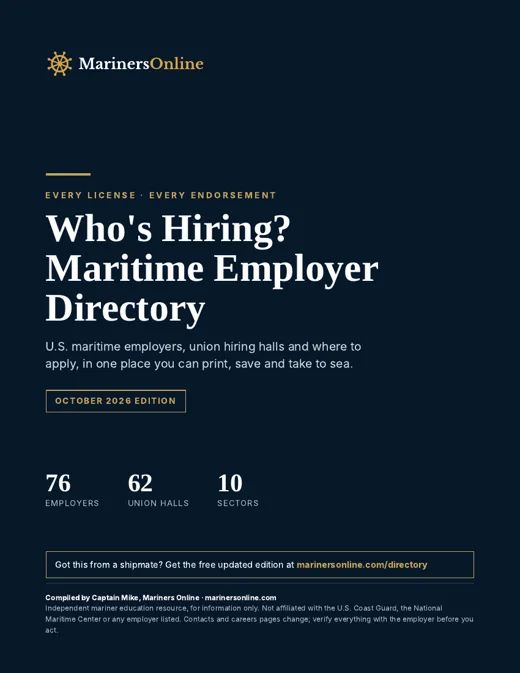
Who’s Hiring? Maritime Employer Directory
76 maritime employers and 62 union hiring halls in one printable PDF: phone numbers, careers pages, a hall map and job call times. Free when you join From the Bridge, Captain Mike's monthly email: rule changes, sea-time tips and new guides, in plain English. One email a month. Unsubscribe anytime.
Sent with Kit. Your email is used only for the directory and this monthly note. See the Privacy Policy.