
Careers › Where Do You Want to Work? › Coasts & Harbors

Facts checked against eCFR, Coast Guard and NMC sources · October 2026
Not every maritime career requires crossing an ocean, working offshore in the Gulf, or spending weeks moving barges down a river.
Some of the most practical maritime jobs are found much closer to shore.
Harbors, bays, coastal waterways and port cities support tugboats, ferries, pilot boats, launches, coastal barges, passenger vessels, research boats, bunkering vessels, dredges and other commercial craft.
For a newcomer, that creates an important career option:
You may be able to build a real maritime career working close to home—or at least much closer to shore than you imagined.
That does not mean every coastal job gets you home every night.
It does mean the maritime industry is much broader than blue-water shipping.
What Do We Mean by “Coasts & Harbors”?
For this page, Coasts & Harbors means commercial vessel work centered around:
- Ports
- Harbors
- Bays
- Sounds
- Rivers near the coast
- Near-coastal waters
- Coastal routes between U.S. ports
- Local passenger and ferry operations
- Ship-assist and terminal work
This is not one Coast Guard credential route.
A harbor tug, commuter ferry, coastal barge and pilot boat may operate near each other while falling under very different manning, route and credential requirements.
So think of Coasts & Harbors as a career category—not a license category.
What Kinds of Vessels Work Along the Coast?
Depending on the port and region, you may encounter:
- Harbor tugs
- Ship-assist tugs
- Coastal towing vessels
- Articulated tug-barge units
- Ferries
- Passenger vessels
- Pilot boats
- Crew launches
- Bunkering vessels
- Dredges
- Survey vessels
- Research boats
- Construction vessels
- Workboats
- Tank barges
- Small cargo vessels
- Government vessels
Some of these vessels may spend most of their time inside a harbor.
Others may travel hundreds of miles along the coast.
That difference matters.
A person who says:
“I want to work on a tugboat”
still has more questions to answer.
Harbor Tugs
Harbor tugs are among the most visible commercial vessels in a busy port.
They may assist large ships while those ships:
- Enter or leave port
- Dock
- Undock
- Turn in confined waters
- Shift between berths
- Move through narrow channels
- Operate with limited maneuverability
The Coast Guard defines harbor assist as the use of a towing vessel during maneuvers to dock, undock, moor or unmoor another vessel, or to escort a vessel with limited maneuverability. (ecfr.gov)
Harbor tug work can involve:
- Fast-paced maneuvering
- Line handling
- Close work around large ships
- Radio communications
- Strong currents
- Tight spaces
- Day and night operations
For someone interested in shiphandling, harbor work can be an excellent long-term career.
It is not “just pushing ships around.”
Deck Work on Harbor Tugs
An entry-level deckhand may help with:
- Handling towlines
- Making up lines to ships
- Line tending
- Deck maintenance
- Safety equipment
- Cleaning and painting
- Preparing towing gear
- Assisting during docking operations
- General vessel duties
On a small tug, the crew is small enough that everybody’s work is visible.
A good deckhand learns:
- Where to stand
- Where not to stand
- How lines behave under strain
- How to communicate clearly
- How to anticipate what the boat will need next
That kind of practical experience can become the foundation for advancement.
The Harbor Tug Wheelhouse Path
A deckhand who wants to advance may eventually pursue towing-vessel officer endorsements.
A simplified career concept might look like:
That is only an illustration.
Actual qualification depends on sea service, route, assessments, TOAR completion, examinations and the specific endorsement being sought.
Coast Guard towing qualifications distinguish routes such as:
- Oceans
- Near Coastal
- Great Lakes–Inland
- Western Rivers
An endorsement may also carry operational or geographic restrictions, such as a harbor-assist restriction or authority limited to a designated local area.
Those restrictions are not interchangeable with the route itself.
Read the actual authority and limitations on the credential rather than relying on the job title.
Coast Guard guidance provides for harbor-assist restrictions in certain towing-officer qualification pathways. Applicants must still satisfy the applicable service, assessment and other requirements. (dco.uscg.mil)
A harbor-assist restriction limits the work the credential authorizes.
It is not the same as unrestricted towing authority.
Do not assume:
“I work in a harbor, so I need a harbor-assist endorsement.”
The endorsement needed depends on the officer position, vessel, route and operation.
Start with the job.
Then check the applicable Coast Guard pathway.
Harbor Assist Is Not the Same as Coastal Towing
A harbor-assist tug may spend most of its career helping ships maneuver inside or near a port.
A coastal tug may move a barge between ports over near-coastal or ocean routes.
Those operations can involve very different:
- Voyage lengths
- Weather exposure
- Watchstanding
- Towing arrangements
- Crew schedules
- Route authority
Do not infer authority from a route name alone.
The endorsement, route, restrictions and applicable qualification pathway must match the actual operation.
That is one reason a mariner should always ask:
What route is this vessel actually operating on?
Coastal Towing
Coastal towing may involve moving barges between ports along the Atlantic, Pacific, Gulf or other U.S. coastal routes.
Cargoes can include:
- Petroleum products
- Construction materials
- Containers
- Equipment
- Bulk cargo
- Project cargo
- Aggregate
- Other domestic freight
Vessels may tow barges astern, push them, operate alongside, or work as part of an articulated tug-barge unit.
Compared with harbor tug work, coastal towing may involve:
- Longer trips
- More time at sea
- Weather exposure
- Offshore watchstanding
- Different towing gear
- Different route qualifications
- Living aboard for extended periods
A person who likes tugboats but wants longer voyages may find coastal towing more appealing than harbor assist.
What Is Near Coastal?
Near Coastal is a defined Coast Guard term.
Under 46 CFR 10.107, it generally means ocean waters not more than 200 miles offshore from the United States and its possessions. (ecfr.gov)
That does not mean every vessel operating within 200 miles of shore uses the same endorsement.
The credential required still depends on:
- Vessel
- Position
- Tonnage
- Route
- Duties
- Applicable regulations
A ferry running inside a bay and a tug towing a barge offshore may both be “coastal” in everyday conversation.
They are not necessarily the same credentialing situation.
Ferries
Ferries can be a practical sector for newcomers to investigate.
They may carry:
- Passengers
- Vehicles
- Freight
- Bicycles
- Commuters
- Tourists
Ferry operations range from small local vessels to large multi-deck passenger and vehicle ferries.
Jobs may exist in:
- Deck
- Engine
- Galley
- Passenger service
- Maintenance
- Terminal operations
A ferry job may involve living ashore and reporting for shifts.
Or it may involve longer routes and vessel rotations.
Do not assume every ferry means:
“Home every night.”
Ask.
What Can You Learn on a Ferry?
Depending on your department and assigned duties, ferry work may involve:
- Docking and undocking
- Passenger operations
- Navigation
- Watchstanding
- Machinery operations
- Safety drills
- Line handling
- Schedule discipline
But the experience you gain depends on the job you actually hold.
A passenger-service employee may work aboard the same vessel as the deck department without performing deck watchstanding, machinery or line-handling duties.
That distinction matters if you are choosing the job partly for future credential advancement.
Passenger-Vessel Work
Not all passenger work is traditional ferry work.
Commercial passenger vessels can include:
- Harbor tour boats
- Dinner boats
- Whale-watch vessels
- Sightseeing vessels
- Excursion boats
- Water taxis
- Small cruise vessels
- Charter vessels
For someone moving from recreational boating toward professional work, this sector can be especially relevant.
But remember:
Carrying paying passengers changes the regulatory picture.
Do not assume experience operating your own boat automatically qualifies you to operate a commercial passenger vessel.
Appropriate Master or Mate endorsements depend on the vessel, route and passenger operation involved.
Pilot Boats
Pilot boats transport maritime pilots between shore and arriving or departing ships.
That sounds simple until you consider the operating environment.
Pilot boats may work:
- Day and night
- In rough weather
- Near large moving ships
- Offshore of the harbor entrance
- On tight schedules
Crew positions may involve:
- Vessel operations
- Transfers
- Deck work
- Maintenance
- Communications
- Support duties
Pilot-Boat Crew and Maritime Pilots Are Different Careers
The pilot-boat crew operates and works aboard the launch.
A maritime pilot is the experienced navigator who boards another vessel to provide local pilotage expertise.
Those are completely different careers.
A newcomer may find deck or support positions aboard pilot boats and launches where employers hire inexperienced applicants.
Operating the boat is a separate position requiring the qualifications applicable to that vessel and service.
Crew Launches and Harbor Service Boats
Busy ports also use smaller commercial vessels to move:
- Crewmembers
- Technicians
- Inspectors
- Agents
- Supplies
- Spare parts
- Documents
These may be called:
- Launches
- Crew boats
- Water taxis
- Service boats
This is exactly the kind of maritime work many newcomers never realize exists.
Some jobs are aboard modest-sized commercial boats doing useful work inside one port every day.
The vessel may not look impressive on social media.
It may still be a very good doorway into the industry.
Bunkering and Fuel Operations
Ships need fuel.
Harbor bunkering operations may involve:
- Tank barges
- Tugs
- Bunker vessels
- Terminal support
Working aboard a bunker barge, assisting with cargo operations and serving as the Person in Charge of a transfer are different assignments.
Current Coast Guard terminology includes endorsements such as Tank Vessel-PIC and Tank Barge-PIC, along with related tank-vessel qualifications. (dco.uscg.mil)
Determine which endorsement and cargo qualifications apply to the actual duties before purchasing training.
Do not treat “tankerman training” as one generic course that automatically qualifies you for every tank-vessel job.
Dredging and Harbor Construction
Ports do not stay usable by accident.
Dredges and marine-construction vessels help maintain:
- Channels
- Berths
- Turning basins
- Bridges
- Piers
- Breakwaters
- Shorelines
Possible vessels include:
- Dredges
- Tugs
- Workboats
- Crane barges
- Survey vessels
- Construction barges
- Material barges
These jobs can be excellent for people who prefer practical, project-oriented maritime work over traditional shipping.
Some positions may be vessel-based.
Others may be shoreside.
Some may involve both.
Shore-based terminal or construction employment should not automatically be assumed to provide qualifying vessel sea service.
Engine Careers in Harbor and Coastal Work
Smaller commercial vessels still need skilled engine personnel.
Depending on vessel size and staffing, engine work may involve:
- Diesel engines
- Generators
- Electrical systems
- Hydraulics
- Pumps
- Steering systems
- HVAC
- Preventive maintenance
- Repairs
- Troubleshooting
A harbor tug may have a much smaller engineering department than a large ship.
A large ferry may have a more formal engine-room structure.
A workboat may expect mechanically inclined crewmembers to perform multiple duties.
For someone who likes machinery more than navigation, coastal and harbor work offers plenty of options.
What Are the Schedules Like?
This may be one of the most important differences between coastal and deep-sea careers.
There is no single harbor schedule.
Jobs may involve:
- Day shifts
- Night shifts
- 12-hour watches
- Multi-day rotations
- Week-on/week-off arrangements
- Equal-time rotations
- Trip-based assignments
- On-call work
A ferry job may resemble shift work.
A harbor tug may use a multi-day rotation.
A coastal tug may have the crew living aboard for weeks.
A launch employee may report daily.
Before applying, ask:
- How long is the normal hitch?
- Do I live aboard?
- Do I go home after each shift?
- What are the watch schedule and rest arrangements?
- Where do crew changes occur?
- Is transportation provided?
- How is compensation calculated?
- How are any applicable overtime, travel and delay payments handled?
- Can schedules change with vessel traffic?
The word harbor tells you where the boat works.
It does not tell you when you go home.
Can I Start With No Experience?
Potentially, yes.
Harbor and coastal employers may hire for:
- Entry-level deck positions
- Deckhand jobs
- Ferry positions
- Galley work
- Entry-level engine work
- Deck or support positions aboard launches
- Workboat jobs
- Terminal-support positions
Some companies provide significant training.
Others expect credentials or prior experience.
Not every entry-level harbor or coastal job requires an MMC, and not every position has the same medical or training requirements.
Determine the requirements for the particular vessel and assigned job.
The right approach is the same one we use throughout Mariners Online:
Find the job first. Then determine what the job requires.
Do not buy four maritime courses because somebody at the marina said they “couldn’t hurt.”
Your wallet may disagree.
What Credentials Do I Need?
There is no single coastal-mariner credential package.
Requirements depend on the:
- Vessel
- Route
- Tonnage
- Position
- Passenger capacity
- Inspection status
- Duties
- Employer
You may encounter:
- Transportation Worker Identification Credential (TWIC)
- Merchant Mariner Credential (MMC)
- Coast Guard Medical Certificate, when required
- Drug-testing requirements
- National deck or engine endorsements
- Towing-vessel qualifications
- STCW endorsements, when applicable
- Radar training or endorsement requirements, when applicable
- Appropriate Master or Mate endorsements for passenger-vessel operations
- Tank-vessel qualifications
- Employer-specific training
This list does not mean every coastal job requires all of them.
A TWIC concerns transportation-security access.
It is not a professional operating license and is not a substitute for an MMC when an MMC is required.
Before paying for training, ask:
- What documents must I hold to apply?
- What must I hold before joining the vessel?
- What training does the employer provide?
- Is a listed qualification legally required, an employer requirement or simply preferred?
Do I Need STCW?
Not automatically.
U.S. regulations provide an STCW exemption for vessels operating exclusively on the inland waters of the United States. (ecfr.gov)
Coastal or seagoing operations require a separate check.
Domestic employment does not automatically mean STCW is unnecessary, and proximity to shore does not determine the answer by itself.
Check the:
- Vessel
- Operation
- Tonnage
- Position
- Applicable exemptions
Keep three categories separate:
- National credential requirements
- STCW requirements
- Employer training requirements
Do not buy STCW training solely because the job advertisement contains the word coastal.
Local Work Does Not Mean Easy Work
A vessel can operate within sight of shore and still involve serious seamanship.
Harbor and coastal mariners work around:
- Large ships
- Narrow channels
- Bridges
- Traffic
- Strong currents
- Fog
- Wind
- Tides
- Shoaling
- Night operations
- Commercial schedules
A harbor tug may operate within a few miles of its dock and still perform difficult shiphandling every day.
A ferry can make the same crossing repeatedly and still require careful navigation, machinery reliability and disciplined passenger-safety procedures.
Distance from land is a poor measure of how professional the job is.
Where Are the Jobs?
Coastal and harbor maritime work exists around much of the United States.
Major employment areas include ports and waterways along the:
- Atlantic Coast
- Gulf Coast
- Pacific Coast
- Great Lakes
- Alaska
- Hawaii
- U.S. territories
The more useful question for a job seeker is:
What commercial vessel activity occurs near the port I am considering?
One harbor may be dominated by container ships and ship-assist tugs.
Another may have ferries.
Another may support fishing, passenger vessels and launches.
Another may be heavily industrial.
Look at the work actually being done.
A Practical Starting Plan
1. Pick the Kind of Work
Compare:
- Harbor tug
- Coastal towing
- Ferry
- Passenger vessel
- Pilot boat or launch
- Dredging
- Marine construction
- Harbor service
2. Decide Whether You Want Local or Rotational Work
Ask yourself:
- Do I want to live aboard?
- Do I want to return home after a shift?
- Am I willing to work nights?
- Would I rather travel between ports?
- Do I want a fixed schedule or vessel rotation?
3. Pick a Department
Deck if you enjoy vessel operations, line handling, navigation and outside work.
Engine if you prefer machinery, systems and troubleshooting.
Galley or passenger service if crew or passenger support fits you.
4. Find Actual Employers
Read current postings.
Look for:
- Entry requirements
- Credential requirements
- Schedule
- Reporting location
- Vessel type
- Training provided
- Advancement opportunities
5. Get Only What You Need
Separate:
- Coast Guard requirements
- Employer requirements
- Helpful-but-optional training
before spending money.
6. Get Aboard and Document Your Service
Your first coastal job may provide:
- Experience
- Skills
- Industry contacts
- A better idea of what you want next
- Qualifying sea service, depending on the vessel, position, duties and endorsement you later pursue
That last distinction matters.
Not every maritime job provides the same credential credit.
Document Your Sea Service
Record:
- Vessel name
- Official number
- Vessel type
- Tonnage
- Propulsion and horsepower when relevant
- Position served
- Dates aboard
- Days worked
- Hours worked per day
- Route and waters operated
- Duties performed
Route matters.
Service on a harbor tug, near-coastal towing vessel, ferry or passenger vessel may be evaluated differently depending on the endorsement you later pursue.
Keep your own records, but obtain proper sea-service documentation acceptable to the National Maritime Center. (dco.uscg.mil)
Shore-based terminal work does not automatically count as vessel sea service.
Do not assume somebody else will still have perfect records five years from now.
What Can Coastal and Harbor Work Lead To?
A first job can lead toward:
- National Able Seafarer ratings
- Mate or Master endorsements
- Towing-vessel officer endorsements
- Harbor-assist work
- Coastal towing
- Ferry operations
- Passenger-vessel command
- Tank-vessel work
- Pilot-boat operations
- Port operations
- Marine construction
- Dredging
- Shoreside vessel management
If STCW Able Seafarer–Deck becomes relevant to your career, remember that it is a separate STCW qualification from the national Able Seafarer ratings.
A local deckhand job can become a long career.
Or it can become the first step toward something larger.
Both are legitimate outcomes.
Is Coasts & Harbors Work Right for You?
This sector deserves a serious look if you:
- Want commercial maritime work without immediately committing to deep sea
- Like smaller vessels
- Want frequent vessel handling and port operations
- Prefer domestic work
- Are interested in tugs or ferries
- Want to investigate jobs near major ports
- Prefer the possibility of shorter rotations
- Want to build practical maritime experience
It may be less attractive if your main goal is long ocean passages, international travel or large blue-water ships.
That is the point of exploring the career before choosing the credential.
The Bottom Line
You do not have to cross an ocean to become a professional mariner.
Harbor tugs, ferries, pilot boats, launches, dredges, passenger vessels and coastal towing operations offer real careers throughout the United States.
For a newcomer, start with four questions:
- What commercial vessels operate near the port I am interested in?
- Do I want harbor work or longer coastal voyages?
- Which department fits me?
- What qualifications do actual employers require?
Then work backward.
Your Next Step
- Interested in towboats and barges? Read Working the Rivers: Towboats, Barges & Inland Maritime Careers.
- Interested in offshore Gulf work? Read Gulf Coast Maritime Careers.
- Interested in tugboats specifically? Explore Tugboats, Towboats & Barges.
- Interested in local passenger work? Review ferry and passenger-vessel career guidance.
- Already aboard? Review Documenting Sea Service before your records get harder to reconstruct.
Who’s Hiring: Coasts & Harbors
Our Tugs & Barges directory lists harbor and coastal towing employers, and the Who’s Hiring quick list covers ferry and passenger-vessel operators, all with links to their own careers pages.
Harbor tug employers → Coastal towing employers → Ferry employers → Passenger vessel employers →Do not dismiss a job because the boat never gets far from land.
A harbor tug working a containership, a ferry carrying passengers and a pilot boat meeting a ship offshore are all serious commercial-vessel operations.
The distance from the dock does not determine the value of the experience.
Pick the work that fits you.
Then build from there.
Official Sources
- 46 CFR 10.107 — definitions including Near Coastal and harbor-assist operations.
- 46 CFR 15.1101 — STCW applicability and exemptions.
- U.S. Coast Guard National Maritime Center — current towing-vessel officer checklists, national endorsements and credential requirements. (Master of Towing Vessels · Mate (Pilot) of Towing Vessels)
- U.S. Coast Guard NVIC 03-16 — towing-vessel officer qualification pathways, assessments and harbor-assist restrictions.
- U.S. Coast Guard Towing Vessel National Center of Expertise — guidance concerning vessel staffing, professional credentials and required documents.
- National Maritime Center Sea-Service Guidance — evaluation and documentation of qualifying maritime service.
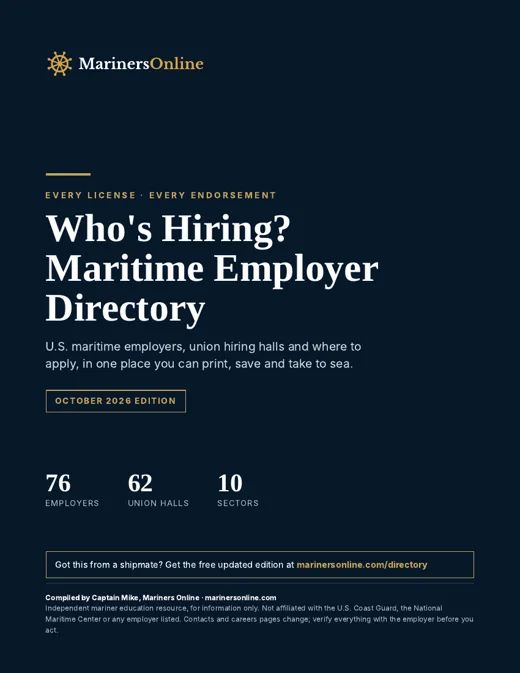 FREE DOWNLOAD · OCTOBER 2026 EDITION
Who’s Hiring? Maritime Employer Directory
76 maritime employers and 62 union hiring halls in one printable PDF: phone numbers, careers pages, a hall map and job call times. Free when you join From the Bridge, Captain Mike's monthly email: rule changes, sea-time tips and new guides, in plain English. One email a month. Unsubscribe anytime.
Sent with Kit. Your email is used only for the directory and this monthly note. See the Privacy Policy.