
Careers › Where Do You Want to Work? › Inland Rivers

Facts checked against eCFR, Coast Guard, NMC, Army Corps of Engineers and AWO sources · October 2026
When someone says merchant mariner, most people picture a ship headed across the ocean.
They probably do not picture a towboat pushing barges past Memphis, locking through the Ohio River, moving grain down the Mississippi, carrying petroleum products along the Gulf Intracoastal Waterway or working a barge fleet outside St. Louis.
That leaves out a major part of American maritime work.
The tugboat, towboat and barge industry is the largest segment of the U.S. domestic maritime industry, according to the American Waterways Operators. That description covers the broader towing and barge industry—not river towing alone. (americanwaterways.com)
For someone considering maritime employment, river and inland towing can offer a career that looks very different from deep-sea shipping.
You may work with smaller crews. You may spend much more time handling lines and barges. You may navigate rivers instead of oceans.
And your first job may be aboard a towboat rather than anything resembling the ships most people associate with the Merchant Marine.
First: Towboat or Tugboat?
Newcomers often use tugboat and towboat to mean the same thing.
They are related, but the work can look very different.
Towboats
The classic inland towboat usually pushes barges ahead of it.
Despite the name, it often does much more pushing than towing.
On the Mississippi, Ohio and other inland rivers, a towboat may move a group of barges assembled into a large unit called a tow.
From the wheelhouse, the operator controls not only the towboat but the entire collection of barges ahead of it.
The result can be a very large vessel combination moving through bends, bridges, locks, currents and commercial traffic.
Tugboats
Tugboats may push, pull or tow alongside. They are commonly associated with:
- Harbor ship assist
- Coastal towing
- Barge transportation
- Construction and dredging support
- Shipyard and terminal work
Federal towing-vessel regulations recognize pushing, pulling and hauling alongside as towing activities. (ecfr.gov)
For a newcomer, the important lesson is simple:
Do not assume every towing job looks the same because the boat has tires hanging from the side.
River towboats, harbor tugs and coastal towing vessels can involve different work, schedules and credential paths.
What Is a Barge?
A barge is generally a vessel designed primarily to carry cargo rather than provide its own propulsion.
Many barges are moved by towboats or tugboats.
Common inland cargoes include:
- Grain
- Coal
- Stone and aggregates
- Fertilizer
- Steel
- Petroleum products
- Chemicals
- Construction materials
- Machinery and project cargo
Some barges are covered dry-cargo barges. Some carry liquid cargo in tanks. Others are open hopper barges or specialized units designed for particular trades.
A single towboat may move multiple barges at once. That is one reason inland waterways can move large quantities of freight efficiently.
Where Does River Work Happen?
The inland marine industry is much larger than the Mississippi River alone.
Commercial waterways include portions of the:
- Mississippi River
- Ohio River
- Illinois Waterway
- Tennessee River
- Cumberland River
- Arkansas River system
- Red River
- Atchafalaya River
- Gulf Intracoastal Waterway
- Missouri River and connected commercially navigable waterways
- Columbia and Snake River system
Different waterways support different types and volumes of commercial traffic.
Some depend heavily on locks and dams. Others involve long free-flowing sections. Some connect directly with Gulf and coastal operations.
So “river job” is almost as broad a description as “ship job.”
Line-Haul, Fleeting and Harbor Work
Not every river towboat does the same kind of work.
One of the first distinctions to understand is the difference between longer-distance transportation and local barge handling.
What Is Line-Haul Towing?
A line-haul towboat moves barges over longer distances through the river system.
Crews may live aboard while the vessel travels between terminals, fleets and cargo locations.
The work can involve:
- Long periods underway
- Lock transits, depending on the route
- Crew changes away from home
- Changing river conditions
- Barges added or removed along the way
- Day and night operations
This is closer to the traditional image of a career river mariner.
But even here, operations vary considerably by company and route.
What Is a Barge Fleet?
A barge fleet is an area where barges are staged, assembled or separated before continuing their trip.
Fleeting and harbor boats may work within one river area, port or terminal system rather than making long voyages.
Jobs can involve:
- Moving barges between docks
- Building and breaking tow
- Spotting barges at terminals
- Assisting larger towboats
- Moving equipment locally
- Organizing barges for their next movement
For someone entering the industry, fleet work can provide hands-on experience with lines, barges and close-quarters operations.
It may also offer a different schedule from line-haul towing.
Do not assume, however, that “local work” automatically means a particular shift or going home every night. Ask the employer how the job actually operates.
What Is It Like Working on a River Towboat?
Life aboard an inland towboat can be very different from life aboard a deep-sea ship.
A river crew may spend much of its time working around:
- Barges and fleets
- Locks and terminals
- Docks and bridges
- River currents
- Changing water levels
- Commercial traffic
Instead of a long ocean passage, the operation may involve a continuing sequence of bends, bridges, traffic, docks and tow work.
The boat itself may also be much smaller than an oceangoing ship.
That can mean fewer people aboard and less separation between departments.
On a smaller crew, everybody tends to learn fairly quickly who contributes and who spends considerable energy trying to avoid it.
Entry-Level Deck Work
For many newcomers, the first river job is some form of deckhand position.
Job titles and assigned duties vary by company.
An entry-level deckhand may help with:
- Handling lines
- Building and breaking tow
- Securing barges
- Checking wires and rigging
- Cleaning and painting
- Routine maintenance
- Preparing barges for movement
- Assisting during lock transits
- Helping at docks and terminals
- General vessel duties
This is physical work.
It can involve working outside in heat, cold, rain, wind and darkness. Deckhands may move between the towboat and barges and work around heavy lines, wires, winches and moving equipment.
The river does not care that you are new.
That is why training, supervision and asking questions matter from the beginning.
Before accepting a position, ask how the company trains new deckhands, who supervises them and how employees report an unsafe condition or stop to ask for help.
Building and Breaking Tow
One of the defining skills of inland towing is learning how barges are assembled into a tow.
Barges may be connected with wires, rigging and other securing arrangements so that multiple barges behave as one unit when being pushed.
Deck crews may help:
- Position barges
- Catch and pass lines
- Handle ratchets and wires
- Secure barges
- Inspect connections
- Break barges out of the tow
- Reconfigure the tow for locks or terminals
This work is one reason experienced river deckhands become valuable.
There is a large difference between understanding the idea of making up a tow and being able to do it safely at 2:00 in the morning in bad weather with current running.
Tank Barges
Not every barge carries grain or stone.
Tank barges carry liquid cargoes such as petroleum products and chemicals.
These operations can involve additional safety, training and endorsement requirements depending on the cargo and the mariner’s duties.
If tank-barge work interests you, do not assume that an entry-level deck position qualifies you to take responsibility for cargo transfers.
Identify the actual job and review the applicable tank-vessel qualification guidance before purchasing training.
A tank barge may look simple from shore.
The paperwork and operating requirements usually are not.
Find out exactly what job you are applying for—and which cargo duties you will perform—before purchasing tank-vessel training.
Engine-Room Careers on Towboats
Towboats need engineering and maintenance too.
The exact staffing arrangement varies by vessel and operation.
Engineering work may involve:
- Diesel engines
- Generators
- Fuel and cooling systems
- Pumps
- Hydraulics
- Electrical equipment
- Steering systems
- Preventive maintenance
- Repairs underway
Smaller towboats may not have an engine department resembling that of a large ship.
That can make inland towing interesting for mechanically inclined people who like being close to the machinery and directly involved in repairs.
Do not assume, however, that every inland engine job has the same credential requirements. Determine what the particular vessel and position require.
What About Galley Work?
Towboats operating on extended trips may carry cooks or crewmembers assigned food-service duties.
On a small vessel, the galley can be an important part of crew life.
A crew may live together in a relatively confined space for weeks at a time.
Good food will not solve every crew problem. Bad food can certainly create a few.
Galley arrangements vary by company and vessel. Ask whether cooking is a dedicated position or part of another crew assignment.
Locks and Dams Are Part of River Life
Many inland waterways depend on locks and dams to maintain navigation pools and allow vessels to move between different water elevations.
For example, the U.S. Army Corps of Engineers maintains 19 locks and dams along the 981-mile Ohio River navigation system. (hec.usace.army.mil)
A tow moving through a lock system may have to:
- Approach the lock
- Wait for traffic
- Separate into smaller sections if necessary
- Enter the chamber
- Secure as directed
- Rise or fall with the water level
- Exit and reassemble as required
For the deck crew, that can mean line handling and close attention to the movement of the tow.
For the wheelhouse, it means controlling a large vessel combination in confined water.
Not Every River Has Locks Everywhere
The inland system is not uniform.
The Lower Mississippi, for example, operates very differently from lock-and-dam waterways farther north.
Current, water level, traffic and channel conditions can become more prominent concerns than lock operations.
An operator who knows one route should not assume another river is simply the same job with different scenery.
River Levels Matter
River navigation changes with the water.
High water can increase current and reduce bridge clearances. Low water can restrict available draft and channel width.
Shoaling, sediment, debris and changing channel conditions can affect navigation.
Applicable federal towing-vessel navigation rules require river-stage or water-surface-elevation information for Western Rivers operations. (ecfr.gov)
That tells you something important about river navigation:
The river you sailed last month may not behave exactly like the river you are sailing today.
What Schedules Do River Mariners Work?
There is no single river schedule.
Companies may use rotations in which crews work aboard for a block of days or weeks and then receive scheduled time off.
Fleet boats, harbor work and local towing may operate differently from line-haul towboats.
Before accepting a job, ask:
- How many days are normally spent aboard?
- How much scheduled time off follows?
- Is transportation to the vessel provided?
- Where are crew changes conducted?
- Are travel days paid?
- Are meals provided aboard?
- How is compensation calculated, including any applicable overtime?
- Can the schedule change if the vessel is delayed?
- Are you assigned to one boat or dispatched wherever needed?
- What are the watch schedule and rest arrangements?
A company’s rotation can affect your life as much as its hourly rate or day rate.
Living Aboard a Towboat
River mariners may live aboard while on rotation.
Accommodations vary. Depending on the vessel, crewmembers may have private or shared rooms, common bathrooms, a galley and small recreation spaces.
This is not a cruise ship.
You are living at work.
That means a good river mariner learns something beyond boat handling:
how to live with other people.
A person who is difficult for eight hours ashore can become fairly impressive after fourteen days in a small steel box.
Professionalism matters.
The Work Can Be Dangerous
River work involves real hazards, including:
- Falling overboard
- Heavy lines and wires
- Pinch points
- Slippery barge decks
- Moving machinery
- Extreme heat and cold
- Fatigue
- Current
- Working at night
- Transfers between vessels and barges
Falls overboard are a recognized safety concern in towing operations. Coast Guard–American Waterways Operators safety materials specifically address their prevention. (americanwaterways.com)
A new deckhand should understand this from the beginning:
The safest mariner is not the person trying hardest to look experienced.
Listen.
Ask when you do not understand.
Learn where not to stand.
Follow your employer’s safety procedures and required protective-equipment rules. Do not treat asking for clarification as a weakness.
What Credentials Do I Need to Start?
This is where newcomers should resist the urge to buy every course advertised online.
Requirements depend on the:
- Vessel
- Job
- Route
- Employer
- Assigned duties
- Cargo carried
Not every entry-level inland towboat deckhand position requires a Merchant Mariner Credential.
Applicable manning requirements, the vessel’s required staffing and the assigned position matter. (dco.uscg.mil)
A position may involve some combination of:
- Transportation Worker Identification Credential, or TWIC
- Merchant Mariner Credential, or MMC
- Coast Guard Medical Certificate, when required
- Employer physical or fitness requirements
- Drug-testing compliance
- Appropriate ratings or officer endorsements
- Employer training
- Tank-vessel qualifications, when applicable
A TWIC is a Transportation Security Administration identification credential used for unescorted access to secure areas of regulated maritime facilities and vessels.
It is not a Coast Guard license, and it does not authorize someone to operate a towboat.
Do not assume every document in this list applies to every job.
Ask the employer exactly what you must hold before hiring, what is required before assignment aboard and what training the company provides.
Find three or four companies doing the work you want and read their actual entry-level requirements before spending money on training.
Let the job tell you what you need.
Do I Need a Towing License to Be a Deckhand?
An entry-level deckhand does not need a Master or Mate (Pilot) of Towing Vessels endorsement merely to work on deck.
Other credential requirements depend on the vessel, required manning and assigned position. (dco.uscg.mil)
The qualification to operate the vessel is different from the qualifications needed for an entry-level deck position.
Start by determining the requirements of the actual job—not by assuming you need the wheelhouse credential before your first day aboard.
Do I Need STCW for River Work?
Not automatically.
Under U.S. regulations, vessels operating exclusively on the inland waters of the United States are exempt from application of the STCW Convention. (ecfr.gov)
That does not eliminate applicable national credential, medical, safety-training or employer requirements.
Do not assume the same answer applies to a towing vessel operating offshore or on a different route.
Before purchasing STCW training, identify the vessel and job and confirm the requirements that apply.
What Does “Western Rivers” Mean?
This is one of the first terms that can confuse a newcomer.
Western Rivers does not simply mean rivers in the western United States.
It is a defined Coast Guard term covering the Mississippi River and its tributaries, specified connecting waters and additional designated waters.
Consult the complete regulatory definition when determining whether particular waters are included. (ecfr.gov)
That matters because towing-vessel officer qualifications can be route-specific.
Great Lakes–Inland towing authority does not automatically authorize Western Rivers towing service. National Maritime Center guidance identifies additional Western Rivers requirements. (dco.uscg.mil)
When somebody says:
“I’ve got an inland license.”
the next question should be:
“For what vessel and what route?”
Maritime credentials are full of words that sound broader than they really are.
The Wheelhouse Career Path
A river deckhand who enjoys the work may eventually decide to move toward the wheelhouse.
That is a substantial transition.
Operating a towboat requires much more than learning where the steering controls are.
Coast Guard towing-officer pathways include endorsements such as:
- Apprentice Mate (Steersman) of Towing Vessels
- Mate (Pilot) of Towing Vessels
- Master of Towing Vessels
Qualifications and limitations depend on the endorsement and route pursued. The National Maritime Center maintains towing-vessel checklists addressing service, training, assessment and route requirements. (dco.uscg.mil)
Here, Mate (Pilot) refers to a towing-vessel officer endorsement.
A simplified career concept might look like:
This is illustrative, not an automatic promotion ladder or the only qualification pathway.
Actual qualification depends on applicable age, sea service, route, training, examination, assessment and other Coast Guard requirements.
What Is a TOAR?
Anyone seriously considering becoming a towing-vessel officer will eventually encounter another acronym:
TOAR — Towing Officer Assessment Record.
A TOAR records practical towing competencies and a Designated Examiner’s assessment of demonstrated proficiency.
It is an assessment record—not a standalone license.
Passing a written examination is not the same as demonstrating practical towing competence. (ecfr.gov)
Some mariners who already hold qualifying deck-officer endorsements may use an alternative towing-qualification pathway.
That pathway involves more than simply completing a TOAR. Applicable route authority, documented training and observation, and other requirements must also be met. (dco.uscg.mil)
Western Rivers has additional requirements, including specific authority endorsed on the MMC.
Do not assume that completing towing assessments elsewhere automatically authorizes Western Rivers service.
For a newcomer, the immediate lesson is simpler:
Learn that the TOAR exists. Understand that practical assessments matter. Review the detailed pathway when you are ready to pursue the wheelhouse.
River Work Is Not Just the Mississippi
Do not assume this career exists only around New Orleans or St. Louis.
The waterways discussed here connect employment regions across the central and eastern United States, the Gulf Coast and the Pacific Northwest.
Where you live and where you report for crew change may be two different things.
When comparing employers, ask where crews report, how travel is arranged and whether assignments can move between operating areas.
What About the Gulf Intracoastal Waterway?
The Gulf Intracoastal Waterway creates overlap between river careers and Gulf Coast towing.
A mariner may encounter inland rivers, protected Gulf waterways, ports and coastal operations during the same career.
That is another reason to understand your credential’s route authority rather than thinking only in terms of the company you work for.
A company’s operating area is not a substitute for checking what your own qualifications authorize.
What About the Columbia and Snake Rivers?
The Columbia and Snake River system offers another region to investigate for commercial river work.
It is geographically far west, but that does not make it part of the Coast Guard’s Mississippi-centered definition of Western Rivers.
The regulatory term is not a compass direction. (ecfr.gov)
If Pacific Northwest towing interests you, investigate employers and confirm the route qualifications for their actual operations.
What Can River Work Lead To?
An entry-level river job can become a long career.
A deckhand may become a more experienced deckhand, leadman or other senior deck employee, depending on the company’s structure.
Some move toward the wheelhouse.
Others pursue opportunities in:
- Tank-barge operations
- Port and terminal work
- Dredging
- Marine construction
- Vessel maintenance
- Dispatching
- Operations management
- Safety and training
- Shoreside management
Some eventually move into other sectors of the maritime industry.
The first boat does not decide your entire career.
It gives you a place to begin.
Document Your Sea Service
Keep careful records from the beginning.
Record:
- Vessel name
- Official number
- Vessel type
- Tonnage, when applicable
- Propulsion type and engine horsepower, when relevant
- Position served
- Dates aboard
- Days worked
- Hours worked per day
- Route and waters operated
- Duties performed
The National Maritime Center may need these particulars to evaluate whether service qualifies for the endorsement you are pursuing. (dco.uscg.mil)
For towing careers, the route deserves particular attention.
Western Rivers qualifications include route-specific service or training requirements. Service elsewhere does not necessarily substitute for the Western Rivers experience required by the applicable pathway.
Check the current NMC checklist for your intended endorsement. (dco.uscg.mil)
Keep personal records, but also obtain properly completed service documentation acceptable for Coast Guard applications.
Your notebook is valuable.
It is not automatically a substitute for acceptable sea-service evidence.
Do not assume that every day employed or every maritime job provides the same credential credit. (dco.uscg.mil)
A Practical Starting Plan
1. Decide Whether the Lifestyle Appeals to You
Ask yourself whether you are comfortable with:
- Living aboard, where required
- Working outside
- Nighttime work and watch schedules
- Physical deck duties
- Time away from home
- Sharing a small living environment
- Working around heavy equipment
If the answer is no, learn that before buying maritime courses.
2. Compare Different Kinds of River Jobs
Investigate:
- Line-haul towboats
- Barge fleets
- Harbor boats
- Tank-barge operations
- Dredging
- Construction support
- Gulf Intracoastal operations
Do not assume one represents all of them.
3. Find Actual Employers
Read current job descriptions.
Look for:
- Entry requirements
- Crew rotation
- Reporting location
- Pay structure
- Travel arrangements
- Training provided
- Credential requirements
- Advancement opportunities
Ask how inexperienced employees are trained and supervised.
4. Obtain the Required Qualifications
Get what your target job actually requires.
Do not collect training certificates because somebody online said they might be useful someday.
Distinguish government requirements from employer hiring preferences, and confirm both before spending money.
5. Get Aboard and Learn
An entry-level job can help you build:
- Practical experience
- Skills
- Industry contacts
- A reputation
- A better understanding of what you want next
It may also provide qualifying sea service, depending on the vessel, duties and endorsement you later pursue. (dco.uscg.mil)
6. Decide Whether You Want the Wheelhouse
Once you understand towing operations, you can make a more informed decision about pursuing an officer pathway.
Then review:
- Apprentice Mate requirements
- TOAR assessments
- Designated Examiners
- Mate (Pilot) qualifications
- Master of Towing Vessels qualifications
- Route authority
You do not need to master every licensing pathway before your first day on deck.
Is River Work Right for You?
River towing deserves a serious look if you:
- Like hands-on work
- Want to enter commercial maritime employment
- Are comfortable working as part of a smaller crew
- Are interested in towing and barges
- Want to investigate a possible wheelhouse career
- Prefer domestic maritime work over international shipping
- Are willing to compare different vessels, employers and schedules
It may be less attractive if you dislike physical work, confined living arrangements, nighttime duties, time away from home or working outside in bad weather.
There is nothing wrong with discovering that.
The purpose of career research is not to convince everybody to become a river mariner.
It is to help you make the decision before you invest time and money.
The Bottom Line
America’s rivers are working waterways.
Towboats move barges through a transportation network that many people drive over without thinking about.
For a newcomer, that creates a career path hiding in plain sight.
You can investigate deck work, machinery, galley positions and eventual wheelhouse opportunities without beginning with an oceangoing ship.
Start with four questions:
- What kind of boat do I want to work on?
- What does the entry-level job actually involve?
- Which companies hire beginners?
- What qualifications do those jobs require?
Then work backward.
Your Next Step
- New to maritime work? Start with Get Your First Maritime Job.
- Unsure whether deck, engine or galley work fits you? Read Deck vs. Engine vs. Steward.
- Want to compare river, harbor and coastal towing? Explore Tugboats, Towboats & Barges.
- Already building experience aboard? Review Documenting Sea Service.
- Interested in tank barges? Review Mariners Online guidance on tank-vessel qualifications before purchasing training.
Who’s Hiring: Inland Rivers
See inland towing employers in our Tugs & Barges directory, with links to their own careers pages. The Who’s Hiring quick list also shows inland river employers in other industries.
Inland towing employers → All inland river employers →Do not overlook the rivers because the boats are smaller than ships.
A towboat pushing barges through current, bridges and locks is serious commercial vessel work.
Get aboard. Learn the river. Learn the tow. Document your service.
Then decide how far toward the wheelhouse you want to go.
Official Sources
- U.S. Coast Guard National Maritime Center: towing-vessel checklist, MCP-FM-NMC5-28 (PDF) — towing-vessel endorsement checklists, qualifications and assessments.
- 46 CFR Part 136 — towing-vessel terminology, including the definition of Western Rivers.
- 46 CFR 140.705 — charts, publications and river-stage information requirements.
- 46 CFR 15.1101 — STCW applicability and exemptions.
- U.S. Coast Guard Towing Vessel National Center of Expertise — crew credentials, documents and required staffing guidance.
- National Maritime Center Sea-Service Guidance — documentation and evaluation of qualifying service.
- U.S. Army Corps of Engineers — inland navigation infrastructure and lock systems.
- American Waterways Operators — towing-industry information and Coast Guard–AWO safety materials.
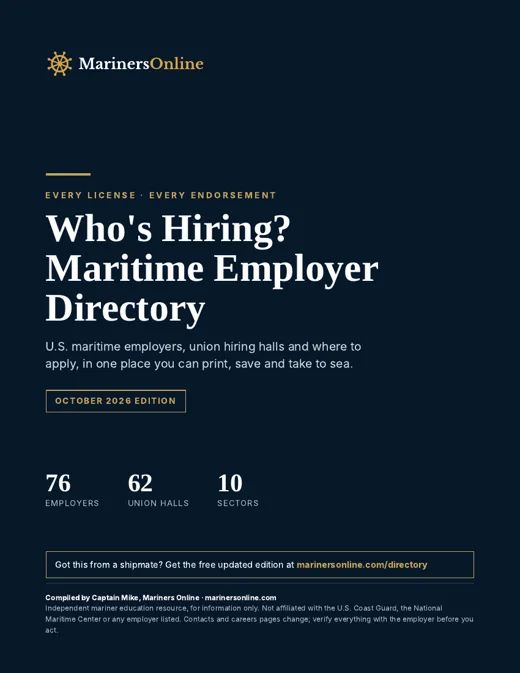 FREE DOWNLOAD · OCTOBER 2026 EDITION
Who’s Hiring? Maritime Employer Directory
76 maritime employers and 62 union hiring halls in one printable PDF: phone numbers, careers pages, a hall map and job call times. Free when you join From the Bridge, Captain Mike's monthly email: rule changes, sea-time tips and new guides, in plain English. One email a month. Unsubscribe anytime.
Sent with Kit. Your email is used only for the directory and this monthly note. See the Privacy Policy.