


Checked against 46 CFR 11.524 and the NMC DDE checklist · October 2026
The short answer
- A Designated Duty Engineer (DDE) endorsement is the Coast Guard’s engineer license for smaller vessels: under 500 GRT (gross register tons), up to the horsepower printed on your credential.
- It’s the usual first license for engineers working their way up on tugs, towboats, offshore supply vessels (OSVs), crew boats and ferries, without going to an academy.
- It comes in three levels: under 1,000 HP, under 4,000 HP and unlimited horsepower. Each needs more engine-room sea time, part of it as a QMED (Qualified Member of the Engine Department).
- It’s a national endorsement for U.S. vessels, not an STCW (international) one.
Engine or deck?
There has always been a rivalry between the engine room and the wheelhouse. In the old days the engineers didn’t think much of the deckies, and the deckies returned the favor. On today’s small crews that doesn’t work. When there are six or eight people aboard, nobody can afford a grudge against a whole department.
The rivalry still gets a laugh, though. The captain is always in charge of the vessel. Some chief engineers have been known to forget that.
I think it’s easier for engineers to move up the ladder than it is for deck officers. If I knew then what I know today, I would have gone the engine side, just because there are more opportunities once you retire. The world is open to engineers. On the deck side, not so much.
That’s one captain’s opinion, not a rule. Both sides need years of sea time, and both licenses are limited by the vessels you served on. For the deckies it’s tonnage. For the engineers it’s horsepower. Deck vs. Engine vs. Steward →
The three DDE levels
| DDE level | Engine-room sea time | Of that, as QMED or equivalent | Minimum age | Where you can work |
|---|---|---|---|---|
| Under 1,000 HP (750 kW) | 360 days (about 1 year) | 180 days | 18 | Near-coastal or inland waters |
| Under 4,000 HP (3,000 kW) | 720 days (about 2 years) | 360 days | 19 | Near-coastal or inland waters |
| Unlimited horsepower | 1,080 days (about 3 years) | 540 days | 21 | Any waters |
All three levels are limited to vessels under 500 GRT. Sources: 46 CFR 11.524, 11.501(c), NMC checklist MCP-FM-NMC5-43.
“Near-coastal” means ocean waters within 200 miles of shore. “Inland” means bays, sounds, harbors and rivers inside the boundary lines. In Coast Guard terms the Great Lakes are a separate route, so a Great Lakes engineer should confirm with the NMC (National Maritime Center) how the endorsement will read.
Horsepower is the engineer’s tonnage. For a DDE, the level you apply for sets the sea time you need. For other engineer licenses, such as Third Assistant Engineer, the horsepower of the vessels you actually served on can limit your license. 46 CFR 11.503 The engine type matters too: at least one-third of your time must be on the propulsion type you apply for, whether motor (diesel), steam or gas turbine.
Sea time: the real hurdle
As with every license and endorsement, sea time is the culprit. It’s hard to come by today. You have to get aboard the right vessels, with the right horsepower for the license you want, and then stay long enough to build up the days.
- What counts: engine-department service, normally 8-hour days, with the required share as a QMED or equivalent. Time as an oiler or junior engineer is the usual way to get it. If you plan to count anything else, ask the NMC before you apply.
- 12-hour days: count as 1½ days only where the vessel’s Certificate of Inspection allows a two-watch system. 46 CFR 10.232(h)
- Deck time: can replace up to 25% of the required time or 6 months, whichever is less. 46 CFR 11.504
- Small boats: on vessels under 100 GRT, time counts only if there’s a walk-in engine room with a plant comparable to a larger vessel.
- Recent service: the regulation asks for 3 months in the past 3 years 46 CFR 11.201(c); under current Coast Guard policy, the NMC accepts 3 months in the past 7 years. CG-MMC Policy Letter 02-25
- Paper: if it isn’t documented, it doesn’t count. Every sea-service letter needs the vessel, dates, position, horsepower and propulsion type.
Documenting Sea Time → · What Counts as Sea Time? →
Wiper to DDE, step by step
Get your first credential and ship out as a wiper
The wiper is the engine room’s entry-level job: cleaning, painting, helping on watch and learning the plant. See TWIC and Your First MMC for the paperwork.
Earn a QMED rating
You need 6 months of service as a wiper or higher, and you must pass the QMED exam. A school-ship program can replace all of that time, and other approved courses can replace up to half. 46 CFR 12.503 See Wiper to QMED.
Stand watches as an oiler or junior engineer
This builds the QMED time every DDE level requires.
Apply for DDE under 1,000 HP
Once you have 360 days in the engine room, 180 of them as a QMED, and you’re at least 18.
Keep sailing and move up
Go for DDE 4,000 HP and then unlimited as your time builds. Before each step, check the NMC checklist to see whether another exam is needed.
Training, exam and paperwork
For an original DDE endorsement, the NMC checklist lists:
- First aid completed within the past year, and CPR that’s still valid. Valid STCW Basic Training covers both.
- Basic firefighting within 5 years of applying. Valid STCW Basic Training counts.
- Advanced firefighting within 5 years of applying. A valid STCW Advanced Fire Fighting course counts.
- A Coast Guard exam, or a Coast Guard-approved course accepted in place of the exam.
- A medical certificate, or an application for one. See Medical Fitness.
- A drug test within the past 6 months.
- Sea-service letters for every vessel, showing horsepower and propulsion type.
- The application (form CG-719B) and fees.
Course approval applies to individual courses, not whole schools. Check that the specific course you book is Coast Guard-approved for what you need. Class Finder →
Military engineers
Engine-room time on Navy, Coast Guard or Army vessels may count toward a DDE, but the NMC decides case by case from your documented duties, the vessel’s horsepower and its propulsion. Don’t assume your service matches a level until it’s evaluated. Military Sea Service →
Where a DDE leads
Afloat. A DDE holder may qualify for STCW engineer endorsements, which open up vessels on international voyages. Each one has its own requirements. 46 CFR 11.524(c) See National vs. STCW. The bigger ladder, from Third Assistant Engineer up to Chief, is covered in the Engine Officer Ladder.
Ashore. This is where engineers have the edge. When an engineer comes ashore, a lot of doors are open. A deck officer’s skills don’t carry over as easily. Shipyards, port engineering, equipment service and plant operations are the kinds of jobs to look into. What you qualify for depends on the employer and your experience, not just the license. Work Ashore → · Sea to Shore →
Common mistakes
- Logging deck time as engine time. If you worked deck on a small boat and helped in the engine room, the letter has to show what you actually did. Deck time can cover only a small part of a DDE (25% or 6 months, whichever is less).
- Leaving horsepower and propulsion off the letter. The NMC needs both. A letter that just says “engineer, 2024” will come back.
- Letting training expire. Firefighting courses must be within 5 years, and first aid within 1 year, for an original application.
- Assuming a shipmate’s path fits yours. Every application is evaluated on its own record. Read the checklist for your exact transaction.
Official sources
- 46 CFR 11.524: Designated Duty Engineer service requirements
- 46 CFR 11.501: Grades of engineer endorsements (DDE limits)
- 46 CFR 11.503: Propulsion power limits
- 46 CFR 11.504: Substituting deck service
- 46 CFR 12.503: QMED service requirements
- 46 CFR 10.232: How sea service is credited
- NMC checklist: National Designated Duty Engineer, MCP-FM-NMC5-43 (September 2025)
- CG-MMC Policy Letter 02-25: Recent service for national officer endorsements (September 2025)
Mariners Online provides educational information. We work to keep it accurate and current, but requirements and approval processes can change. Confirm current rules and your circumstances with the USCG, NMC, or relevant authority before applying, enrolling, or spending money.
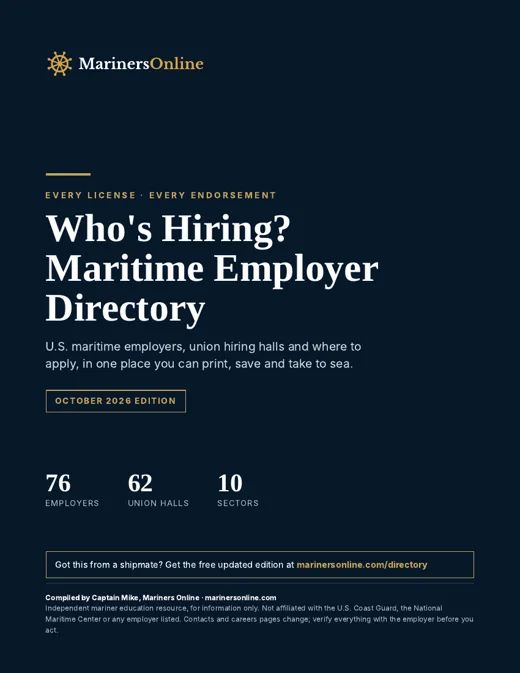 FREE DOWNLOAD · OCTOBER 2026 EDITION
Who’s Hiring? Maritime Employer Directory
76 maritime employers and 62 union hiring halls in one printable PDF: phone numbers, careers pages, a hall map and job call times. Free when you join From the Bridge, Captain Mike's monthly email: rule changes, sea-time tips and new guides, in plain English. One email a month. Unsubscribe anytime.
Sent with Kit. Your email is used only for the directory and this monthly note. See the Privacy Policy.