

Maritime Training & STCW Courses › Online AB Courses

Checked against 46 CFR 12.401–12.409, NVIC 01-26 and school course pages · October 2026
A note on names: the Coast Guard renamed Able Seaman to Able Seafarer in January 2025. Most mariners and many schools still say “AB” or “Able Seaman,” and so do we on this page.
The short answer
- Yes, you can do the study part online. Under NVIC 01-26 (June 2026), the Coast Guard lets schools deliver the AB course in person, blended or fully online.
- You won’t take the final exam from your couch. Even a fully online course ends with a live, proctored final exam at a testing site the National Maritime Center (NMC) has approved, where your identity is checked.
- The course replaces the Coast Guard AB exam. That’s all it does. It doesn’t give you sea time, and it usually doesn’t cover the lifeboat endorsement every AB needs.
- The certificate is good for one year. Don’t start the clock before your sea time is in hand.
If you have your sea time, or you’re close, an approved course is a common way to earn the AB rating without sitting the Coast Guard exam. Just know what you’re buying first.
What an approved AB course does, and doesn’t, do
An approved AB course stands in for the Coast Guard’s professional examination for Able Seafarer. You don’t have to test at a Coast Guard Regional Exam Center. 46 CFR 12.405 46 CFR 12.401(c)(5)
It does not:
- Give you sea service. You still need the deck days for your AB category.
- Get you Lifeboat Operator, unless the package says so.
- Cover your medical certificate, drug test or application.
- Issue your endorsement. You hold the AB rating only when it’s on your Merchant Mariner Credential.
Under NVIC 01-26, an approved AB course should be at least 40 hours. The knot-tying demonstration can be part of it or a separate Marlinespike Seamanship course. More on that in Trap 2.
“100% online” vs. blended: know what you’re buying
The NMC approves each school’s course and its delivery method separately. A school approved to teach AB in a classroom isn’t automatically approved to teach it online. The sites where final exams are given are part of the approval too. NMC, March 2022
| Format | The study part | Exam and knots |
|---|---|---|
| Online | Online modules, usually self-paced | Live proctored final exam at an approved testing site |
| Blended | Online, self-paced or live | One or two days in a classroom for practical work and exams |
| Classroom | All in person | In person |
Examples, from the schools’ own course pages (checked October 2026):
- Maritime Institute (online): the course is fully online; the final exam is in person at its Alameda, San Diego, Norfolk or Honolulu locations.
- Maine Maritime Academy (blended): 40 hours online plus 8 hours on campus, $750.
- MITAGS (blended): 4 days online plus 2 days on campus.
The classroom days in a blended course are for the hands-on work that can’t be done online. That’s how the Coast Guard describes them. If you’re working rotations, a blended course can mean far fewer nights in a hotel. Look up the school’s campus dates before you start the online part, so you’re not left holding a half-finished course. Find current dates on our Class Finder, then confirm with the school.
School details change, and listing a school here is not a recommendation. Check with the school before you enroll.
The 3 traps that cost mariners time and money
Trap 1: The one-year clock
A course certificate that replaces a Coast Guard exam is good for one year. Your application, with the certificate in it, has to reach the NMC within 12 months of finishing the course. NVIC 01-26, Encl. (1) NMC courses FAQ
That application needs more than the certificate:
- Qualifying sea service, documented
- Medical certificate
- Drug test or exemption
- Lifeboat Operator
- The application itself, through Navita
Current deck sea service for each AB category, from the NMC Able Seafarer checklist (January 2025):
| AB category | Deck sea service |
|---|---|
| Unlimited | 540 days |
| Limited | 360 days |
| Special, OSV, Sail and Fishing Industry | 180 days each |
If you see 1,080 days somewhere, that source is out of date. Here’s why the numbers changed →
Do the sea-service math before buying the course.
A classroom certificate cannot create boat time you do not have. Get your sea-service letters in hand and check what counts first. Then start the course, so the one-year clock works for you instead of against you.
Trap 2: The knots are hands-on
The regulation requires you to show you know the principal knots, bends, splices and hitches “by actually making them.” 46 CFR 12.405(c)
Some AB courses include that demonstration; Maine Maritime’s and Maritime Institute’s course pages say theirs do. Other schools handle it in a separate Marlinespike Seamanship course. If a course is advertised as 100% online, ask two questions:
- 1. Does your certificate cover the knot demonstration, or only the written exam?
- 2. Where and how is the knot demonstration done?
Want to practice first? Our Free AB Study Guide includes a marlinespike module.
Trap 3: No lifeboat endorsement, no AB
Every AB endorsement requires Lifeboat Operator or Lifeboat Operator-Limited, the endorsements once called Lifeboatman. 46 CFR 12.401(c)(6)
Many AB courses don’t include it. Maine Maritime’s course page says plainly that its AB course doesn’t meet the Lifeboatman requirements, and Maritime Institute’s says the same of its online AB course. Here’s what to know:
- Lifeboat Operator has its own sea time: 12 months, or 6 months plus an approved course. 46 CFR 12.407
- Lifeboat Operator-Limited is for vessels fitted with liferafts but no lifeboats. 46 CFR 12.409
- The lifeboat course can’t be done fully online. NVIC 01-26 approves Proficiency in Survival Craft courses, the ones that cover the Lifeboat Operator practical, only in person or blended. Plan for time in a real boat.
- PSC (Proficiency in Survival Craft) is the separate STCW endorsement for seagoing ships. It’s not the same as Lifeboat Operator, though one course often covers both.
Lifeboat Operator & PSC explained →
Before you pay: the checklist
- 1. Find the course on the NMC’s approved course list. Make sure the approval covers the delivery method you’re buying: online, blended or classroom.
- 2. Ask what the certificate replaces. It should meet the Able Seafarer exam requirements in 46 CFR 12.405.
- 3. Ask where the final exam and knot demonstration happen. Get the approved testing sites in writing, and check the next available dates.
- 4. Ask whether Lifeboat Operator is included. If not, plan and budget for a separate in-person or blended course.
- 5. Check your sea time first. Make sure your days are documented and add up for the AB category you want, before the one-year clock starts.
Get the answers in writing before you pay.
A school’s website is a sales page. An email that says what the certificate covers, where you’ll test and whether lifeboat is included is something you can hold the school to.
Related guides: Before You Pay for Maritime Training · Documenting Sea Time · NVICs and Approved Training
Official sources
- 46 CFR 12.401: Able Seafarer general requirements
- 46 CFR 12.405: Able Seafarer examination and demonstration
- 46 CFR 12.407: Lifeboat Operator
- 46 CFR 12.409: Lifeboat Operator-Limited
- NVIC 01-26: Guidelines for Coast Guard Approved Training (June 2, 2026), Enclosures (1), (2), (5) and (6)
- NMC checklist: National Able Seafarer (January 2025)
- NMC: Courses FAQ
- NMC: Training and approved courses
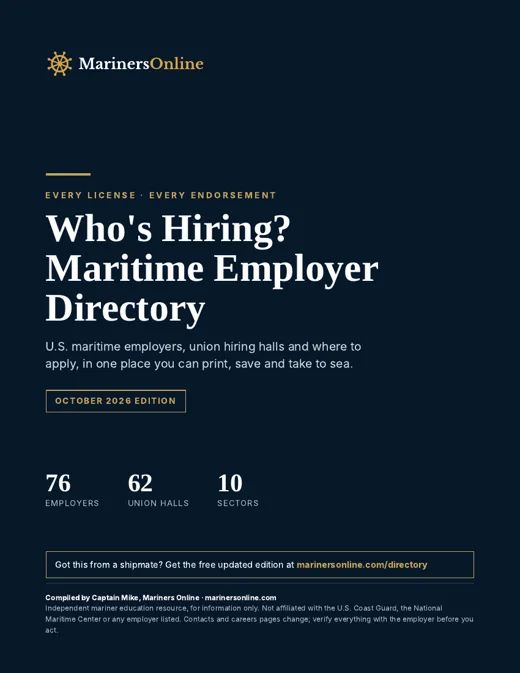 FREE DOWNLOAD · OCTOBER 2026 EDITION
Who’s Hiring? Maritime Employer Directory
76 maritime employers and 62 union hiring halls in one printable PDF: phone numbers, careers pages, a hall map and job call times. Free when you join From the Bridge, Captain Mike's monthly email: rule changes, sea-time tips and new guides, in plain English. One email a month. Unsubscribe anytime.
Sent with Kit. Your email is used only for the directory and this monthly note. See the Privacy Policy.